Thursday, August 31, 2023

The Many Meanings of a Water Lily Pond by Claude Monet and an Untitled Abstract Vista by Al Bright


Water Lily Pond, 1917/19, by Claude Monet, Art Institute of Chicago, 
CCO Public Domain Designation

In a room full of paintings by Claude Monet at the Art Institute of Chicago in July, I was spoiled for choice. I turned and gazed, focusing at first on the Waterloo Bridge and Charing Cross Bridge paintings in which these two structures are obscured by the fog and haze Monet loved to paint (see earlier post). In Waterloo Bridge, Gray Weather, for example, smoke can be seen pouring into the air in the background, and the whole urban riverscape lies beneath a hazy, blurry sky. These London paintings give credence to the thesis of the two climate scientists who argued in a recent study that air pollution "provided a creative impulse" for Monet.

After a while, because there were more than thirty people in the room and most of them seemed to want to take a picture of whichever canvas I was standing in front of, I turned away from the London paintings to look at something more serene, three water lily paintings. In 1893 Monet bought property in Giverny in France where he turned previously marshy ground into a pond, built a Japanese-style bridge over it, and brought in some water lilies. This garden became the subject of most of his later paintings, with a particular focus on the water lilies. 

Water Lily Pond 1900 depicts lush vegetation and is enlivened by the curve of a dark bridge. Swirling masses of water lilies fill the pond, and in the foreground, we can see reflections of trees and other greenery on the banks. Water Lilies 1906 is more abstract and simply shows a few graceful islands of vegetation floating in water that reflects the sky and nearby trees. According to the Art Institute website, as time went on, Monet became less concerned with "conventional pictorial space," and so there is no horizon line. The same can be said of Water Lily Pond 1917/19 in which a somewhat muddy palette of green, pink, purple, white, gray and orange gives depth to the water and allows grassy shapes and shadows to build around a central mass of reflections. Monet’s water lily paintings, according to the Art Institute’s signage, was a “significant part of the inspiration for the abstract artists who flourished later in the twentieth century.” I stood there a long time, taking in this third painting, emerging myself in its somewhat mysterious depths.

Later, at the home of our friends Kathy and Richard in Youngstown, I had a chance to see real water lilies growing in the pond that graces one edge of their garden. The garden is full of herbs, grasses and flowers and is also decorated with small outdoor sculptures, including a few by Akron-based artist Don Drumm. In addition, gazing balls and kinetic wind sculptures give the whole yard a playful and dynamic quality, and when we sat near the pond, we could see frogs hopping onto and among the water lilies. Often there were pink flowers within the masses of the large, round, glossy leaves. But one thing about the water lilies themselves was that their charm and beauty didn’t really call to mind Monet’s canvases. One difference, of course, is that they may have been of different species, but more importantly, Monet's later works were too abstract, too focused on irregular masses of vegetation and reflections in the water to give any real sense of what water lilies are like. Well and good. The master painter shows us the world as he chooses. But there may have been more to it than that. 

Water lilies in the pond in Kathy and Richard's garden

According to Dr. Michael F. Marmor, during the years in which Monet was painting in his garden at Giverny, his vision was progressively affected by cataracts. By the mid-1910s, Monet said that "…colors no longer had the same intensity for me," and he began to trust the labels on tubes of paint rather than his own vision. By the early 1920s, Monet thought he might have to stop painting altogether, and he was aware that he couldn't really discriminate color. His work at that time appeared increasingly abstract, though there was nothing in his correspondence to suggest that he was being influenced by the abstract painters of the early 20th century.

Because there is good historical documentation of Monet's progressive vision loss due to cataracts, we can assume that the changes in his painting style may have been affected by his eye problems. Speaking as an ophthalmologist and not an art critic, Dr. Marmor is careful to add that we can’t make these kinds of judgements about every work of art we see. "It would be presumptuous,” he says, “to assume that nonrepresentational painting implies poor visual acuity or that painting with strong colors (or a lack of color) implies that the artist has cataract or color vision abnormalities." Yes, of course! But it’s a documented fact that Monet's work darkened and became more abstract as his cataracts worsened, which makes it all the more intriguing that, though these late paintings were not particularly influential during Monet’s lifetime, they had a tremendous impact on future directions in the visual arts, especially here in the United States.

Writing in The Brooklyn Rail, art historian and critic Norman Kleeblatt reviewed a 2018 exhibit at l'Orangerie in Paris that purported to show the affects Monet's later work had on the American art scene in the mid-twentieth century. He says that the advocacy of the American Abstract Expressionists helped to bring attention to Monet's later painting, which is why the Paris exhibit displayed Monet's late works next to paintings by American artists who were influenced by it. Kleeblatt says that, at one and the same time, "... late Monet could be explained and exploited as foreshadowing the origins of the large-scale gestural canvases, close chromatic range, and all-over compositions of the American painters." These late Monet's were often dismissed for just these reasons -- "their narrow range of dark color, and seemingly direct depiction of the natural world" seemed "either too romantic or too Symbolist." Or worse, they were disparaged as the work of an artist who had cataracts and very blurred vision. But, Kleeblatt tells us, Monet’s influence was strong enough in the mid-twentieth century that two painter/critics began to call the work of their peers Abstract Impressionism.

The exhibit also strengthened the connection by showing a film of Jackson Pollock dripping paint on canvas “alongside a film of a white-suited Monet painting on an easel in his celebrated garden.” This was likely to be the short film available online today, which shows Monet in 1915 as an assured and masterful painter, looking relaxed in his white suit. He can be seen holding his palette, making thoughtful strokes with his brush and referring frequently to the nearby pond where there are, recognizably, water lilies growing. We can't really follow his progress on the canvas, but when the camera pulls back, we can see how lush and filled with foliage his garden was.

My untitled Al Bright painting

Now back to Ohio where we not only spent time in our friends’ garden, but also stayed again in their Mid-century Modern house, with its eclectic mix of vintage furniture and other well-chosen items. Framed posters, photos and works of art abound, but new this year was an untitled work by Youngstown artist Al Bright. I was especially excited to get to know it, because it was mine, a gift from Kathy because I really enjoy Bright’s work. During our stay, I went from time to time to gaze at it, pleased by its palette of pale honeyed beige tones, with a bit of brown, gray and white in the lower half of the canvas, and more yellow tones in the upper half. There are strong horizontal brush strokes, and nearly in the middle of that upper lighter space, there's a semi-circle that looks like a setting sun cut off by a bank of clouds. 

In a description on the website of the Butler Institute of American Art about a recent show featuring eight of Bright's works, he is described as "an artist who truly understood the handling of paint" and as a "remarkable colorist." Bright died in 2019, but there are a number of videos online in which you can watch him painting to live jazz. In each we see the work of a strongly gestural painter, an action painter. Watch him painting while Art Blakey and the Jazz Messengers are playing, and you can see the spontaneity of his work and its energy. His improvised art accompanies improvised music, and Bright can be seen to respond in a heartfelt way to the music that he hears. 

Writing in the Pittsburgh City Paper in 2013, Robert Raczka says that Bright deserves to be celebrated for the forty years he spent "translating the sound and energy of jazz into visual expression," while maintaining a consistency of style, color choices, and techniques. Raczka even mentions Bright's frequent use of circles in his compositions, which is at least partially the case in my untitled painting. He also refers to Bright as a "third-generation Abstract Expressionist," saying that his work is closest to the “mellow imagery” of Sam Gilliam and Helen Frankenthaler.

About her own work, Frankenthaler once said, "My pictures are full of climates, abstract climates, and not nature per se. But a feeling. And the feeling of an order that is associated more with nature." And this year, writing in The New Yorker about an exhibit of Frankenthaler’s work at Gagosian, Johanna Fateman has said that the artist’s canvases present “sweeping abstract vistas that recall the roar of waterfalls and crashing waves, as well as silent deserts.” Both Frankenthaler’s and Fateman’s notions help me to express the feeling my untitled Al Bright canvas elicits from me, with its predominance of sandy tones, reliance on horizontal lines and its hemicircle central shape that calls to mind a sun. The abstract vista it implies for me is a desert heatscape, the sun's energy pouring down on some monumentally barren place, calling to mind the planet Arrakis in Frank Herbert's
Dune, calling to mind a future earth scorched by climate change. Not that, I think, Bright was ever a pessimistic artist, but this is something I find in this nearly monochrome work, and it gives me, as Frankenthaler says, a feeling of an order associated with nature. And that order is what happens when hot and dry are imposed by an intense and unforgiving sun as climate change proceeds apace.

Smoky skies above the Youngstown area on July 17, 2023,
caused by Canadian wildfires.

Because this has been a summer of Canadian wildfires, it wasn’t a surprise that we experienced a day of smoky skies and dangerous levels of particulates when we were in Ohio. I’m no stranger to smoky haze over the Youngstown landscape because when I was growing up there the mills were still going strong. In fact, I remember that we accepted that smog and soot because the mills brought a certain kind of prosperity, just as Monet had a positive response to the smog and smoke he saw, which gave him a sense that the world was changing in dynamic and exciting ways. But on July 17, the smoky sky implied nothing but climate devastation and rather than being a harbinger of prosperity, it was a warning that humans need to change our ways soon or something that looks a lot like Al Bright's abstract vista may come to pass.


Thursday, August 17, 2023

We Looked for Kenneth Patchen in Ohio, But We Couldn’t Find Any Trace of Him Until We Got Home

Kenneth Patchen (December 13, 1911 – January 8, 1972), American poet and
novelist. Photograph by Chester Kessler, circa 1952.
Fair use,
https://en.wikipedia.org/w/index.php?curid=38096697

I’m a lifelong admirer of the poet Kenneth Patchen, and while I was in Youngstown last month I decided to go and look at his birthplace. He was from Niles, Ohio, after all, and I figured there should be a plaque or monument or at least a sign somewhere in Niles to show that this fearless and peace-loving poet got his start there. But though we searched online and asked at the McKinley Memorial Library (Niles' branch of the public library, which did have a few volumes of Patchen’s poetry), there didn’t seem to be any acknowledgement that Patchen was a native son. (To be accurate, he is listed on the Niles Wikipedia page under “Notable people.”) 

Near the library, a statue of another of Niles’ Notable people, President McKinley, gives the 25th president the appearance of a Greek or Roman orator, and it stands in the courtyard of a lavish neoclassical building that honors him. In that building there’s a welcoming little museum, and we also asked there about whether or not there was a memorial for Kenneth Patchen nearby, but no one knew. Why, I wondered, doesn’t Niles celebrate the poet who clamored for peace every chance he got? Wouldn’t that help to counteract in some small way the fact that McKinley's life was ended by an act of violence, by assassination?

Permanent memorial to the birthplace of President William McKinley, 25th President
of the United States in Niles, Ohio. Photo by Lilly Conforti, CC BY-SA 4.0 via Wikimedia Commons

There was a time when more was made of Patchen in his native state, and for a few short years, there was a Kenneth Patchen Festival in Warren. I attended the Festival in 1989, and I met Miriam Patchen and asked her to sign my copy of Patchen’s Collected PoemsBut the present-day indifference to Patchen in Niles saddened me. When I got back to Tucson and had access to my books again, I organized a little Kenneth Patchen Festival of my own. I celebrated the diversity of Patchen’s work as a visual artist, a poet, and a playwright, much as the 1989 Festival did. But because this was a very small and private festival, I focused on a limited sampling of each aspect of his life’s work.

 As always, I started with the visual. I have a copy of What Shall We Do Without Us? The Voice and Vision of Kenneth Patchen, which was published by Sierra Club Books in 1984 and contains 37 color images of Patchen's Picture Poems. In a review of the book that appeared in the Christian Science Monitor, Steven Ratiner gave a thorough and respectful description of Patchen as a visual artist, noting that the spinal injury that kept the poet in nearly constant pain for most of his adult life caused him to spend his last 13 years in bed. It was during this time, when he couldn't find the strength and energy to work on longer writing projects, that he began to produce his Picture Poems.

According to Ratiner, Patchen, who was not trained as a graphic artist, was influenced by William Blake's illustrated books, and art critic Alfred Frankenstein called Patchen "probably the most sophisticated primitive in the history of American art." Ratiner says the creatures in Patchen's Picture Poems affect us profoundly. "Seemingly childlike, realized with a surprising simplicity of form, they establish a powerful bond with their audience," projecting an aura that is "wise, magical, yet quite vulnerable," and he says Patchen was influenced by Klee and Miro.  In fact, Patchen’s drawings remind me more of those of Karel Appel, who helped form the CoBrA group and who was also inspired by Klee and Miro. 

I decided to choose a Picture Poem from the book and look at it carefully, the way I do when I’m writing an ekphrastic essay. I chose the one which says, “The best hope is that one of these days the ground will get disgusted enough just to walk away - leaving people with nothing more to stand on than what they have so bloody well stood for up to now.” This Picture Poem, like Patchen’s many other such works, features alert-looking creatures that remind us of animals and birds, though the one at the bottom of the page, with six legs, a tail, a head like a hillock and a long brown body has flowers sprouting from its front and back and seems to be the ground that is getting disgusted enough to walk away. Its head and body are ochre-colored, which is appropriate because ochre is a clay earth pigment, and this adds to the notion that this creature is actually meant to be the ground. Its eyes are intense and golden, and it has a bemused expression on its face, gazing at the viewer in a slightly helpless way, standing firmly on its little stubby peg-like legs, like a dog that’s just about had enough. Its tail is not wagging. 

Two other creatures nearly fill the rest of the image, outlined against a yellow background and jockeying for space amidst the hand-lettered text of the poem, the last bit of which extends along the body of the standing ground. One of the creatures is a mix of animal, vegetable, and human, wearing leaves for hair and with a small tail, human-like legs and an elephantine sort of nose. It seems to be stepping down off the ground as it looks at us with one eye, the way someone does in an ancient Egyptian image, its head and body in profile and its eye gazing forward. The other creature is birdlike with swirling feathers and a pointed beaky face. It’s doing a good job of standing its ground and seems calmly balanced. Both creatures are yellow and blue. 

But people are the subject of this Picture Poem, and none of these creatures are people. People are the ones who would be left with nothing more to stand on except for that which they have stood for, which sounds like an angry condemnation of people as a species, implying that they have stood for some terrible things. And, of course, they have. Yet when you look at the faces of all three creatures, you don’t really feel as though they or Patchen are angry at you. Instead, they seem to say that you had better be sure that you stand for something ethical and reasonable and well-thought-out, so you will have something to stand on under trying and difficult circumstances, which seems like sound advice to me.

A few books from my Kenneth Patchen collection.

For the second act of my small festival, I spent some time reading older poems from Patchen’s Selected Poems, concentrating on the ones that have the most to do with Youngstown (when it was a steel town) and on the air Patchen and I breathed there (though not concurrently). “Orange Bears” (from Kenneth Patchen: Selected Poems) is one of the most anthologized of Patchen’s poems and appears many places on the internet. It’s a poem about childhood, but it’s also very clearly about environmental and economic justice. The orange bears that played with the poet when he was ten could have been stuffed animals or imaginary friends, but what happens to them is a reflection of something very real. The orange bears have their backs “seared by hot slag,” and they also have their “soft trusting/ Bellies kicked in.” The ideas expressed in these descriptions alternate between what happens to the land in a steel town and what can happen to the people.

As the poet goes down by the “smelly crick” to read Whitman, he realizes that you have to have lived in a mill town to understand these injustices, because even Whitman, who was the quintessential poet of the American people, didn’t know much about “the National Guard coming over/ From Wheeling to stand in front of the millgates/ With drawn bayonets/ Jeering at the strikers…” And at the end the poem turns again to the air and the water and the land and tells us that “…you could put daisies/ On the windowsill at night and in/ The morning they’d be so covered with soot/ You couldn’t tell what they were anymore.” In this poem the industrialists who own the mills are shown to be just about everything the orange bears are not. Which is why the bears didn’t stand a chance where Patchen grew up in the 1920s and I grew up in the 1960s. Now the mills are gone and the jobs are gone and most of the most damaging effects on the river and the air are gone, but the sadness remains.

And though you might think that “And May I Ask You a Question, Mr. Youngstown Sheet & Tube?” (also from Selected Poems) is going to be an even more intense poem about those same issues, it is and it isn’t. It does start out lamenting “…the yellow-brown smoke/ That blows in/ Every minute of the day. And/ Every minute of the night,” but then there’s some dialogue between people who turn to alcohol in order to survive the exploitation and the gloom. And there’s less of a clear connection to issues of environmental justice and more of a dramatic portrayal of how people try to keep themselves from despairing when work is hard and unrelenting. At the poem’s end, in spite of death and sadness and living with “the taste of tar in your mouth,” the poet announces that “[t]he day shift goes on in four minutes.” In this way Patchen comments on the routinized and standardized life of shifts and schedules that dominated people’s lives when the mills were operating 24 hours a day. Now that they are not, people must fend for themselves and the lack of the taste of tar isn’t always appreciated.

Finally, looking for a third act for my festival, I turned to Patchen as a playwright and listened to a 1942 radio play called “The City Wears a Slouch Hat,” which I found online quite by accident. It features a “sound score” by John Cage, which was commissioned by CBS’ Columbia Workshop to accompany a play written by Patchen. I was drawn to it because I encountered Cage’s avant-garde music the same year I first read Patchen, in 1970. Cage also directed the "orchestra of sound players,” consisting of five percussionists. There are gongs and chimes and bells and cymbals that fill in for the sounds of rain and ocean waves in the play, though sound effects are also used. In the play an unnamed man, referred to in the credits as "The Voice" wanders the cityscape on a rainy night, talking to people, generously giving a panhandler some money and listening patiently to a distraught woman. He also survives being mugged and harassed by street toughs, and he shows himself to have strange and more-than-human powers as, for example, when he goes up to answer a ringing phone on the sixth floor of a nearby building in order to tell the caller that a family will die in ten minutes time. We are given clearer evidence that he really has such abilities when we learn that he already has a picture of his mugger in his wallet and knows that the three men who later follow him have no bullets in their revolvers.

At one point he simply says "Let's walk up and look around in the sky a bit." The percussion score during that sequence is especially resonant, and it ends when he says, "We better get back down, I guess." But The Voice isn't the only person who has had unreal and unexpected experiences: one man tells another about a talking horse, there's a machine that laughs and a woman who claims to have had a terrible accident with broken glass that disfigured her, yet she is not scarred and won’t explain. Toward the end of the play The Voice recites some poetry ("The Passionate Shepherd to His Love" by Christopher Marlow and "Death, be not proud" by John Donne), and then he swims out to a rock in the ocean to get away from the city noise and strife, where he muses that "I'll enjoy being alone..." But he soon encounters a man who says he lives on that rock because he got "sort of tired of things onshore. Men and women doing the same stupid things over and over. And the noise of the city..." As he speaks, the sounds of percussion -- the gongs and chimes – substitute for the frenzy of the waves.

After listening to what the man on the rock has to say, The Voice turns his attention to the need for getting along with the other people around us and finding a way to accept the crowds in the city. A slouch hat, which the city is said to wear according to the play’s title, is mostly a military sort of headgear, and in the play the city is depicted as a place that can cause people to be defensive and fearful. But The Voice cautions against this in his small final soliloquy, saying: "We were not meant to be strangers to each other. We have the same fears, the same hopes, joys, and sorrows. We must not be suspicious. We must learn to love each other.” This might be a somewhat straightforward way to end such an avant-garde play, but it’s a message that seems entirely appropriate coming from Kenneth Patchen.

In this play, as in his other work, Patchen advocates harmony and compassion. In his above-mentioned Christian Science Monitor review, Steven Ratiner talks about the "powerful pacifist message" of Patchen's art, and he notes that interest in Patchen's writing was strong during the decade of the Vietnam war, which is when I discovered him. Ratiner says that the poet’s work gained attention again in the 1980s "when speculation about nuclear war and the survival of the planet [arose] in daily conversation and newspaper headlines.” Since those speculations are just as apropos today, I hope there will be a resurgence of interest in Kenneth Patchen's work, which also contained a great deal of wisdom about how human beings can learn to live together without violence.


Wednesday, August 9, 2023

An Ekphrastic Look at Monet’s Gare Saint-Lazare and Our Recent Amtrak Trip


Arrival of the Normandy Train, Gare Saint-Lazare (1877). Public Domain
Oil on canvas, 60.3 × 80.2 cm (23.7 × 31.6 in). Art Institute of Chicago

Our Amtrak trip from Tucson to Chicago last month was marked by a lulling rhythm-of-the-rails state of mind that allowed us to sleep even when the train whistle hooted all night long. The food is really pretty good and was made even better by the constantly changing views of the countryside that slipped by as we ate. We could see New Mexico skyscapes along the Sunset Limited portion of the trip, and later we had a chance to look over all those Texas towns we’ll never visit during the 24 hours the Texas Eagle spent in its namesake state. The transition from the West, with its calm arid landscapes, to the East with more grass and trees and population density, is always worth commenting on when you wake up 48 hours into the trip and see the Mississippi River and St. Louis’ Gateway Arch.

Of course, along the way, we experienced the frequent, low-level frustration of being kept motionless as freight trains passed our train, leaving it shuddering in the wake of one of Union Pacific’s rude giants. (Amtrak says that for more than 50 years freight railroads have, by law, had to give Amtrak "preference" to run passenger trains ahead of freight trains, but freight lines tend to ignore the law and it's hard for Amtrak to enforce it. This gives the Sunset Limited an on-time performance of only 19%.)


Amtrak in Benson, AZ 
https://www.flickr.com/photos/petegregoire/, CC BY 2.0

We also had a much longer delay just outside Chicago when there was an accident at a poorly marked crossing, and I thought the day-long layover we had set up for ourselves in the Loop might evaporate altogether. That’s why when we finally made it to the Art Institute, and I was standing before “Arrival of the Normandy Train, Gare Saint-Lazare” as a kind of appetizer before I made my way to the room that’s filled with Monets, I enjoyed my fellow-feeling with the artist, who also loved trains, and I felt a little bit superior to him because he loved those dirty steam engines that clouded up the sky, whereas modern diesel trains are much cleaner (and electric trains are even more so). I also now know something about Monet that I didn't know back in the 1960s and 1970s when, feeling privileged to be at the Art Institute, I would stare for hours at all the impressionist treasures I could wrap my gaze around.

Claude Monet, as it turns out, was a connoisseur of the industrial smog of late nineteenth and early twentieth century Europe and London. According to a recent study, the thick smog of the early Industrial Revolution may have inspired Monet (and British painter JMW Turner, whose work was also included in the study) to depict the world, as the title of the ARTnews article about the study has it, as though in a "dreamlike haze." Anna Lea Albright, coauthor of the study, told CNN that, as air pollution levels increased, “The contours of their paintings became hazier, the palette appeared wider, and the style changed from more figurative to more impressionistic: Those changes accord with physical expectations of how air pollution influences light.” Not everyone agrees with this -- Sebastian Smee, art critic at the Washington Post, disagreed with the study's authors that the creation of Impressionism could be explained so simply, but even he doesn't doubt that "Monet was responding to an increasingly polluted environment." 

The painting of Gare Saint-Lazare at the Art Institute is dated 1877, and according to Jean Renoir in his biography of his father, Monet not only worked to emphasize and celebrate smog and fog in his paintings of the station, he even talked the stationmaster into stopping the trains for the best composition and stoking them up so they would produce even more smoke. In spite of the industrial intensity of the scene in this painting, however, the palette is soothing: blue, gray and white predominate, except for the greenish station floor. According to the museum label, this work is darker and less abstract than later works, giving a fairly clear view of the station, the approaching train, the glass-paneled roof and the buildings in the background. Yet there's something cool and dreamy about the scene itself, in spite of the steamy sky and the approach of a gigantic machine, maybe because there's still some space in the foreground from which we watch the train. It’s as though the excitement that Monet must have felt about the huge energy of the train as it moved so many people and barreled its way into the station was outweighed by his appreciation of its beauty. We now know that those steam engines weren’t very good for the environmentand the passengers must have experienced harmful levels of smoke if they sat in cars with open windows. But Monet considered them to be a feast for the eyes, if not for the other senses.

Our own decision to take the train on our trip east this summer had mostly been a matter of convenience, but we also wanted to be more environmentally friendly than we were on last year’s car trip. Was that the case? Greta Thunberg travels by train, which is something of an endorsement, and according to the same BBC article in which I learned about Ms. Thunberg’s travel arrangements, train travel "virtually always comes out better than plane, often by a lot.” Unfortunately, diesel trains' carbon emissions are as much as two times those of electric trains, and of course Amtrak trains are diesel-powered. But according to the Amtrak website, “rail travel produces up to 83% fewer greenhouse gas emissions than driving and up to 73% fewer emissions than flying, making Amtrak the best option to shrink your travel carbon footprint.” They also say, “According to the 2021 U.S. Department of Energy Data Book, Amtrak is 46% more energy efficient than traveling by car and 34% more energy efficient than domestic air travel.” 

And not only is travel by rail a greener option, it has other benefits as well. We like to read and write and daydream, and a long train trip is a good chance to do all those things. Our trip was a relaxing experience, for the most part, but I admit that I also felt some anxiety on the trip because I know sharing the track with freight trains can have hazardous consequences. Later, while visiting friends in Youngstown, Ohio, we made a brief visit to East Palestine, the site of a Norfolk Southern train derailment, where there was a “controlled” burn of five boxcars of vinyl chloride and the spread of harmful chemicals throughout the area. Six months later, the cleanup is still ongoing, and area residents are still worried about health consequences. (See this opinion piece at The Hill by E. Palestine resident Misti Allison.)

In a recent article at NPR called "After the East Palestine train derailment, are railroads any safer?" Erika Ryan reported that, though there used to be a four-person crew on a freight train, over time, crew members like flagmen were considered unnecessary. The freight industry now wants trains to have one worker on board: an engineer, in spite of the fact that there’s been a move toward longer trains, some of them three miles long and maybe more than 20,000 tons. Ryan also said that the freight industry's business model, known as PSR (precision scheduled railroading), which was meant to make the trains run more efficiently, has resulted in large numbers of layoffs, and, "Freight workers across multiple class I railroad companies have told NPR that nearly every aspect of their job has changed as a result of PSR -- including reductions in time dedicated to locomotive maintenance, inspections and training." As a result, these workers said that derailments like the one that took place in East Palestine were inevitable. And even in East Palestine, there's still lots of freight traffic. At one point when we were there, two behemoth freight trains passed each other, travelling in opposite directions, holding up traffic and making an intense amount of noise.

Railway ticket for the Texas and Pacific Railway. The trains were designated as
"Eagles"--Texas Eagle, etc. Circa 1950s. Public Domain.

The pitch and duration of a train whistle make it a mournful sound, one which we heard many times on our Amtrak trip, and stories about derailments and so-called bomb trains gave anxious overtones to those sounds. It made me even more uneasy to learn that there is only one human being on those freight trains, and that person is charged with making sure nothing goes wrong. How can a small flesh and blood person keep track of three miles of diesel-driven metal, weighing many tons? It is the hubris of the rail companies that makes it possible for them to think this is possible, and each time a huge train raced past our Amtrak train, I thought about how hard that lone engineer’s job must be. As I write this and I look again at an image of Monet’s Gare Saint-Lazare painting, I remember that, although the train in the painting was a steaming, roaring monster, at least there were enough human beings around to bring it to heel so Monet could paint it as he chose.

Thursday, March 9, 2023

An Ekphrastic Essay About Paul Bunyan and Tree Equity in Tucson


Image Credit: David Bradley (b. 1954), Chippewa, Another Minnesota Folk Legend, 1987, oil on canvas. Collection of the Tucson Museum of Art. Gift of James T. Bialac.

Recently when I was listening to the Ralph Nader Radio Hour, I was surprised to hear a short discourse on the legend of Paul Bunyan during an episode about a book called The Commercial Determinants of Health. Nader was interviewing one of the book’s editors, Dr. Nason Maani, who said that "…our health is largely shaped by forces outside of health care…” These forces include whether or not we breathe clean air, how well off our parents are, if we live in a polluted neighborhood or live in a house near a highway. And of course some of these forces are determined by the actions of corporations, which is why big companies spend a great deal of time and money trying to affect our perceptions of them and influence our willingness to consume their products and tolerate the health consequences they bring us. Nader gave as an example of such corporate puffery the use of the legend of Paul Bunyan to encourage people to associate the destructive process of logging with the heroic and larger-than-life adventures of an American folk legend. He said that pamphlets about Bunyan were distributed at his school when he was a child, and he called Bunyan “a fictional creature of the lumber industry.” Then he added, “And the last line of the [pamphlet]  was, ‘And Paul Bunyan and the Blue Ox will continue until the last tree is down.’” 

Shortly after I heard that Nader program, I went to the Tucson Museum of Art and saw the exhibit called Enduring Legacies: The James T. Bialac Indigenous Art Collection,  which just opened in February of 2023. The exhibit features a large and extremely impressive collection of American Indian art from the late 20th and early 21st centuries, and it was donated to the TMA by Bialac. The museum worked with indigenous scholars to mount this exhibition, and there’s a focus on community and nature. It includes work by a Pueblo artist I first encountered in Albuquerque -- Diego Romero, whose “Saints and Sinners” deals with Spanish colonization of Pueblo people. There's also work by Tohono O'odham artist Michael Chiago, whose “Spirit Dancer” shows off his knowledge of dance as well as his artistry. But when I saw David Bradley's “Another Minnesota Folk Legend," I couldn't help but think about what Nader had to say about the story of Bunyan and his ox, Babe. Though the painting is relatively small (25 by 20 inches), it had a powerful effect on me, and I understood why Bradley portrayed Bunyan as a monstrosity of sorts, a creature that Native people, dependent on the forest, were bound to be horrified by.

Valerie K. Verzuh, who wrote Indian Country: The Art of David Bradley, says that Bradley’s "... meticulous attention to the surface gives each area of the composition equal significance and resists focal points, inviting viewers to wander the canvas from top to bottom, following lines, shapes, colors, and concepts." But when I stood in front of "Another Minnesota Folk Legend,” I  couldn’t force myself to give equal attention to all parts of the painting. The sight of Paul Bunyan and the highly feminized ox, Babe, portrayed in the top half of the canvas lost out to the familiar-looking trees and animals and the understandable reactions of the native people portrayed in the bottom half of the canvas. Verzuh also says that Bradley acknowledges the power of iconic images and “… delights in deconstructing these images to examine how they convey meaning, and then reconstructing them, injecting each with irony for comic effect or critical comment.” The humor and irony in “Another Minnesota Folk Legend,” has helped me understand the legend of Paul Bunyan more clearly, though the painting also works to tell a very sobering story. (It is in fact included with other works in a room that is collectively labelled “Storytelling and Community.")

With the exception of the slim crescent moon in the sky, everything on the canvas that's near Bunyan and his ox is unnatural and uneasy. As folklore would have it, Bunyan and Babe tower over the landscape, but they seem more monstrous than legendary. The lumberjack’s expression is hard to read, but his head is tipped back as though he's shouting something or howling at the moon. He carries an axe in one hand and a can of Hamm’s beer in the other. (Note that Hamm’s is brewed in Minnesota, “the Land of Sky Blue Waters.”) Though Bunyan's plaid shirt and jeans are what we might expect to see a lumberjack wearing, Babe the ox is far from a normal bovine. She has human eyes and lips, and the ring in her nose matches the one in her ear. The sidelong glance she gives Bunyan is uncomfortably flirtatious, and on her blue back end she appears to be wearing lacy stockings attached to garters. Whatever Bunyan is shouting or howling, he looks as though he’s upset in a very self-involved sort of way and so he doesn’t seem to notice the stir that he and Babe are causing.

Whatever you can say about the scene taking place below the two gigantic figures, there's nothing really surprising about it. The trees are at a normal scale, showing just how easy it would be for Bunyan to take them down with one swipe of his massive axe. Animals flee as they would under such circumstances. Some Native people are in canoes, leaving their shelters in which fires are still burning. A few adults are shooting arrows at Bunyan, but the reaction of the animals and most of the people is to get out of his way. Bunyan is so grotesque that it's sensible to find a vantage point from which to observe him rather than to be squashed by his gigantic feet. The trees, which have white bark and are probably birch trees, are at the mercy of the huge lumberjack. (Note that Bradley’s mother was from the Chippewa nation, and Chippewa people covered their dwellings with birch bark and made birch bark canoes.)

The Bialac exhibit contains many memorable works of art, but I went back a couple of times to look at "Another Minnesota Folk Legend" and decided to write a blog post about it. When I asked myself what a painting about a Northwoods legend has to do with Tucson, I decided that, in addition to the fact that David Bradley attended the University of Arizona before he settled into his life as a New Mexico artist, there's the fact that Tucson has its own statue of Paul Bunyan. Tucson's Bunyan is made of fiberglass, stands 20 feet tall, and has a more pleasant expression on his face than Bradley's Bunyan. He watches traffic go by at the corner of Glenn and Stone, and the statue is a quirky thing to see in a place with more cactus than timber. 

Tucson's Paul Bunyan statue at the corner of Glenn and Stone.

But Paul Bunyan isn't entirely out of place in any corner of the United States. Stories about Bunyan originated in Maine and Canada, and he may have been based on a real French-Canadian lumberjack. But as the timber industry moved westward in order to find new forests to exploit, stories about Bunyan shifted to the Northwoods of Minnesota and Wisconsin and then to the West Coast.  And statues of Bunyan seem to have followed the stories across the country; they can be found in almost every state.  But inevitably the lumber industry saw that Paul Bunyan could be good for their public image, and in 1914 the Red River Lumber Company created pamphlets featuring Bunyan as part of an advertising campaign. A revised version of the pamphlet from 1922 was reviewed by the Kansas City Star, and Bunyan became a kind of pop culture figure and the subject of comics, books, and even an operetta. 

As Marshall Fishwick said in 1959 in "Sons of Paul: Folklore or Fakelore?"  American "folk" heroes are remarkably alike because, though their names and jobs are different, they have all been designed to encourage people to look with admiration at what Fishwick calls "the Big Build-Up." By this he means the ways that development has taken precedence over sustainability in the history of our nation. And though our so-called folk heroes are said to exert superhuman efforts to drill oil (Kent Morgan), dig tunnels (John Henry), drive cattle (Pecos Bill), or make steel (Joe Magarac), all of them are part of the project of turning natural places where American Indians once lived and ecosystems thrived into industrialized and developed spaces that makes big profits for corporations. Our sprawling city regularly participates in “the Big Build-Up,” and trees are often sacrificed to the developers’ needs. 

Though the Sonoran Desert isn't known for having large numbers of trees the way the Northwoods once did, trees are an important part of the ecosystem. People frequently plant native trees like mesquite and palo verde, and there are also many non-native trees like citrus trees and Italian cypresses. As an acknowledgement that trees can improve our wellbeing and the quality of our lives, the City of Tucson under Mayor Regina Romero has been working on its Tucson Million Trees Initiative since 2020. The Mayor has said that she can see and feel the effects of climate change here in Tucson, and she worries about how people will cope with rising temperatures and the high cost of water. She added that "...these impacts are not felt equally across our neighborhoods. Frontline communities of color and lower incomes have been battling these changes for years already. If we are to face this future together, we must address the years of injustice that have left parts of our city hotter, with fewer greenspaces and less investment."  

Planting trees in neighborhoods that need them is one way to address these injustices. There's even a metric called Tree Equity which "helps cities assess how well they are delivering equitable tree canopy cover to all residents." The tree equity score of a neighborhood takes into account how many residents are below the poverty level and other demographic and socioeconomic factors. The neighborhood I live in, Tucson Park West 1, though it's not the wealthiest in the city, gets a Tree Equity Score of 100 out of a possible 100. But many other neighborhoods in which there are a large number of poor people and people of color have some of the lowest scores.

The palo verde tree in front of our house blooms in Spring of 2022

The idea of Tree Equity represents a move toward environmental justice, but the fact that the trees in Oak Flat are in danger of being ripped out to make way for a copper mine shows that the spirit of Paul Bunyan is still present on our land.


Thursday, January 12, 2023

Stone and Rock and Hard Work: Thoughts on a Recent Visit to the Gordon Hirabayashi Recreation Site in the Catalina Mountains

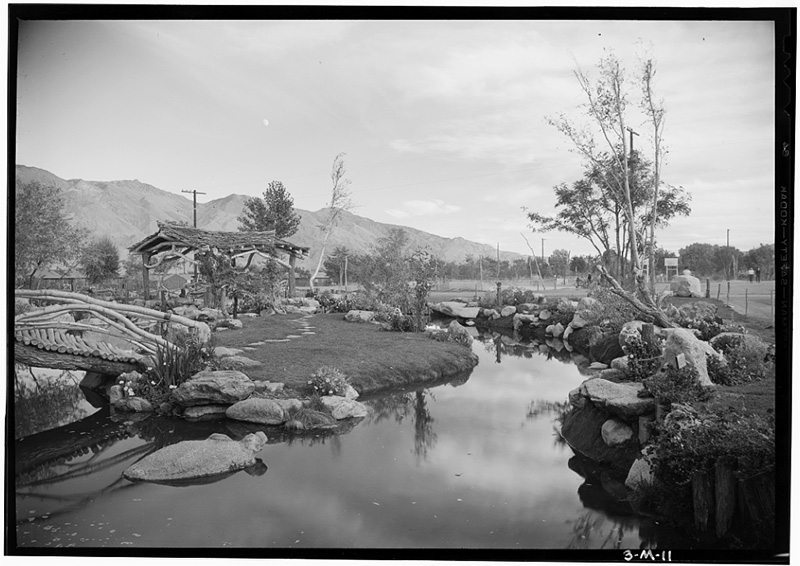
I decided to begin this post with a photograph by Ansel Adams to acknowledge that the WPA photographers played a part in my ability to remember -- and inability to forget -- that nearly 120,000 Japanese immigrants and Japanese Americans were unjustly imprisoned in this country during World War II. Adams was given the job of documenting the Manzanar Relocation Center in California when Dorothea Lange was removed from the project, and he made a number of portraits of people working at the camp. Go to the Library of Congress archive and you can see Adams’ photographs of a mechanic and a nurse   and a woodworker  and a pattern maker and a foreman of power sewing machine workers and a line crew at work  and an electrician  and a tractor driver  and a farmer. Most of those people are identified by name, and they were doing work that needed to be done. All of them were prisoners in the camp at Manzanar.

A couple of months ago when Greg and I went to the Tucson Desert Art Museum, I saw some of the photos of Manzanar and other prison camps taken by Lange and Russell Lee. There, in addition to the exhibit on the Dust Bowl (see previous post), we also saw an exhibit called “Citizen Enemy: Japanese-American Incarceration Camps.” And because the work by WPA photographers affected me and made it hard for me to stop thinking about those incarceration camps, I began to look through other WPA photographs I found online. I was drawn to Adams’ photo of the pool in the pleasure park in Manzanar. It’s an ambiguous sort of landscape -- a welcoming place that's entirely deserted. A graceful bridge and a curvy ramada look as though they were built from found wood, while rocks that came from somewhere else line the pool. Flat stones are incorporated into a walkway, and the mountains form the naturally perfect backdrop. Small trees are reflected in the water. Only a few thin clouds occlude the sky. Yet no one is there to enjoy the pleasure park. Maybe that’s because pleasure is hard to find when you are incarcerated unjustly.  


Pool in pleasure park, Manzanar Relocation Center, Calif. / photograph by Ansel Adams, 1943.

I learned that the rocks in that park came from the nearby mountains when I read Tucson poet Brandon Shimoda’s  “49 Stones for the Poetry of Japanese Incarceration.” In this stunning essay, Shimoda talks about his grandfather, who was incarcerated during World War II, and he interweaves excerpts of the work of other Japanese American poets with descriptions of the activities of Japanese and Japanese American prisoners whose creativity helped them to survive. These creative prisoners included men in Montana who made gifts of the stones they found and then polished, as well as prisoners at Manzanar who “relocated stones from elsewhere” to construct what Adams calls a pleasure park. The poets Shimoda invokes include Brynn Saito, whose “Stone in the Desert Camp, 1942" is told in the voice of a stone found at Manzanar. It begins: “Between the turtle rock and the crane rock/ the children found me. I was shining/ and smooth and silent about my secrets.” Earlier in the essay, Shimoda has told us that “Stones imply a form of communication that enables silence to express itself." He has also already told us that “One of the few things that one can, with any certainty, expect to find in the ruins of Japanese American incarceration—in the physical ruins of the innumerable incarceration sites—are stones.”

And so I thought about the kinds of stone and rock we might see when Greg and I decided to visit the former Federal Honor Camp in the Catalina Mountains on Christmas Day. I thought about stone and rock while we drove from our West-side home to those East-side mountains, a trip we often make on a holiday because traffic is light then. I thought about stone and rock as we drove up the Catalina Highway, which I knew was built by the prisoners at the Catalina Honor Camp. I looked out at the mountain stone and rock as the Sonoran Desert biome, with its arid serenity and impressive array of saguaros, gave way to oak scrubland and chaparral. And as we neared the site of the former prison camp, I wondered how prisoners could have built this road – a series of hairpin turns and S-curves as mountain roads tend to be – when the rock is so massive and the mountainside so dauntingly steep. 

Looking toward Tucson from Soldier Trail in the Catalina Mountains in Coronado National Forest;
photo by Greg Evans 

We parked near the campground at what is now known as the Gordon Hirabayashi Recreation Site and walked over to what’s left of the building that housed prison staff during the war. There are a number of signs that describe what happened there and how the Federal Honor Camp came to include Japanese American prisoners. What’s left of the staff living quarters makes a handsome monument, with a heavy stone staircase leading up the to the foundation of a building that no longer exists. One of the signs answered my question about the hard work of the prisoners who built that road, stating that at first they only had picks, shovels and wheelbarrows, though jackhammers, bulldozers, and tractors were added later, which made the work go faster.  "Before I went to the Honor Camp, I thought prisoners only broke rocks with picks in cartoons," one former prisoner said. 

Stone steps at the site of the former staff residence of the Tucson Federal Prison
Camp, now the Gordon Hirabayashi Recreation Area

The Tucson Federal Prison Camp held a number of men who resisted the draft during World War II, including Hopi and Jehovah’s Witnesses. The first and most famous of the 45 Japanese-American prisoners who were sent there was Gordon Hirabayashi, who had violated federal curfew and evacuation orders. Though he appealed to the U.S. Supreme Court, he lost his appeal and eventually spent three months at the camp. Most of the Japanese American prisoners were also members of a civil rights movement which demanded that men of Japanese descent who were being drafted to fight in World War II should have all the rights of American citizenship or else they shouldn’t have to fight. If they were truly citizens, why were they being sent to prison camps for the non-crime of “looking like the enemy”? If they were dangerous allies of a foreign power, why were they being asked to serve in the U.S. armed forces? In the end, Hirabayashi was pardoned for the crimes for which he had been imprisoned, and the former prison camp he inhabited was named in his honor in 1999. Here, in brief, is how he ended up at the Catalina Honor Camp:

According to Cherstin Lyon in Prisons and Patriotsbecause of Hirabayashi's curfew violation and resistance to evacuation in Seattle, Washington, he was arrested and spent months in King County Jail. When he was finally tried and convicted, he said he didn't want to spend any more time in a "walled institution" but wanted to serve his sentence in a road camp. In order to accomplish that goal, he asked for a longer sentence than the one he had been given initially because that sentence was too short to justify the paperwork that would have been needed to send him to a road camp. He then offered to go by himself to the Tucson Federal Prison Camp. In fact he hitchhiked to Tucson -- a one-month journey of over 1,600 miles from Spokane, Washington – in order to serve his two concurrent ninety day sentences. During the time he was in the Tucson Federal Prison Camp, he was one of the prisoners whose cheap labor helped to finish the Catalina Highway, which extends 24 miles from Gibbons' Ranch to Soldier Camp. The road gains more than 5,200 feet in elevation, which makes it the equivalent of driving from the deserts of Mexico to Canada's alpine forests.  "While building the highway, prisoners busted rocks, hauled pipes, shoveled gravel, and cut this road through an impressively rugged mountainous terrain." (Lyon, p. 111) And among other jobs that Gordon Hirabayashi did while in the camp, including working as a cook and an athletic director, he broke rocks and shoveled gravel, too. (Lyon, p. 117) Though the segregation that was a part of life in the United States during that time also played itself out in the camp, Hirabayashi said that he interacted frequently with the Hopi who were there. They told him they wouldn’t fight the white man’s war, called him a brother, treated him to the ceremony of washing his hair with soapweed and made him tea. (Lyon, p. 113)

One of the signs at the Gordon Hirabayashi Recreation Area; it explains how and why
prisoners at the Tucson Federal Prison Camp built the Catalina Highway.

When I thought about why the men at the Catalina Honor Camp had to work so hard to build a 24-mile mountain road, part of which was constructed without using bulldozers and other heavy equipment, I thought it was possible that those prisoners may have wanted to work outside while they served out their sentences. In fact, at that time Arizona was considered to have more progressive policies regarding the treatment of prisoners than many of the other U.S. states. (Lyon, p. 107) Gordon Hirabayashi himself chose to go to the Catalina Honor Camp for just that reason after all. But what about all those workers Ansel Adams photographed? Why was it that Japanese Americans during World War II were not only imprisoned but had to work their way through this life-shattering experience?

Brandon Shimoda's work gave me a significant part of the answer to these questions, especially in regard to what happened here in Arizona. In the address Shimoda gave at the Holocaust History Center at Tucson’s Jewish History Museum on Inauguration Day in 2017 ("State of Erasure: Arizona’s Place, and the Place of Arizona, in the Mass Incarceration of Japanese Americans"), he said that during the early 1940s, two of the four largest cities in Arizona were concentration camps. Not only that, but the camps in Arizona were the only ones that were on American Indian reservations. This resulted in what Shimoda called a particular relationship between the treatment of Japanese Americans and of Native Americans, and he tied these two things together by introducing Thomas Campbell, an agricultural engineer who was also the Special Investigator of Native American lands for the Department of the Interior. Shimoda went on to say that Campbell “…was obsessed with the enormous number of what he considered worthless parcels of real estate, that were, in the 1930s and 40s, spread throughout the United States, many of the worthless parcels being, in Thomas Campbell’s estimation, on Native American lands. He was also obsessed with the enormous number of projects to reclaim and rehabilitate those worthless parcels of real estate, projects that either were under-funded or had been abandoned." In other words, Campbell thought that millions of acres of natural desert and scrubland and chaparral were without value and needed to be developed and economically exploited. So after Pearl Harbor, he came up with the idea of incarcerating the Japanese and Japanese American people who had been forcibly removed from their homes on those worthless parcels of real estate so they could be put to work building roads and irrigation systems and other projects that needed to be finished. In this way, Shimoda said, Campbell helped add a fourth reason Japanese Americans were rounded up and imprisoned -- beyond the three Congress eventually acknowledged, which were race prejudice, war hysteria, and a failure of political leadership -- and that fourth reason was economic exploitation.

Poston, the largest of the concentration camps, was a beneficiary of Campbell's plan, and many work projects were proposed in order to develop the reservation there. As a result, the Japanese built an irrigation system and schools for the Hopi and Navajo, among other things. I learned more about those projects when I watched the 2009 documentary, Passing Poston: An American Story.  Filmmakers Joe Fox and James Nubile show that Japanese prisoners were brought to Poston on the Colorado River Indian Reservation to build schools, dams, canals, and farms in order that scattered groups of Native Americans could be brought together into one place after the war. In other words, they provided free, forced labor for the American government

Ruth Okimoto, who was imprisoned at Poston when she was a child, later researched the beginnings of the camp and she was startled to find that the Office of Indian Affairs ran Poston along with the War Relocation Authority. According to Michael Tsosie, a historian of the Colorado River Indian Tribes, another government official played a similar role to that of Thomas Campbell; he was John Collier, a commissioner of Indian Affairs in the Roosevelt Administration, who wanted to build an irrigation project to bring Colorado River water to the reservation near Poston so more Native people could be moved to this desert area. "Japanese internment was the justification needed for the expenditure of federal funds," said Tsosie. A council member of the Colorado River Indian Tribes, Dennis Patch, said the house he grew up in was once part of the Japanese barracks. He said that Native people felt bad about the suffering of imprisoned Japanese people and could “identify with mass relocation against our will.” He also noted that American Indian reservations were places where native people were not free to travel at will, and he called Poston “an internment camp within an internment camp.” In commentary included with the DVD I watched, filmmakers Fox and Nubile said that the idea that Japanese Americans were brought to this remote desert location to work and complete projects that would lead to intensification of the control over American Indians was the most startling thing they learned while making Passing Poston.

Of course, Japanese American and Japanese prisoners didn’t just do the work that was imposed on them while they were in the camps; they also engaged in voluntary work as artists and artisans to make their lives a little more satisfying. Many works of art made from found materials were produced in the prison camps. The Ansel Adams photo shows a large-scale example of this  – a garden park made from wood and stone and other materials that were at hand. But there are countless other, smaller examples of arts and crafts ranging from walking sticks and bird pins to watercolor paintings and teapots. I
n the play based on Gordon Hirabayashi's life called Hold These Truths, after his time at the Catalina Honor Camp has ended, he is sent to Idaho where his parents are working the sugar beet harvest. One day his mother gives him a small black stone, which was polished by an artist in another camp when his only son is killed fighting in Italy with American forces. Hirabayashi says the stone shines like a small black moon and has a few tiny characters etched on its surface which say "I carve on this stone from the high plateau, but I have no song." Hirabayashi adds, "So many lost so much. So many lives shattered. So many hopes destroyed." Yet in spite of the sorrows they experienced, artists and artisans in the camps continued their creative work, like the artist who polished the stone Hirabayashi's mother gave him, like the workers who made the pleasure park Ansel Adams photographed, as a way to show that they were not entirely defeated by their experiences.

But being unjustly imprisoned is the kind of experience that can defeat people, make them question their own significance and importance. While at the place that now bears the name Gordon Hirabayashi Recreation Site, I read the signs and thought how unnerved and disrespected these men must have felt when they were given only unacceptable choices, none of which would lead to full citizenship rights. Would they deny their Japanese citizenship? Would they allow themselves to be drafted and possibly die in wartime for a country that didn’t value them as true Americans? The Tucsonians, as the Japanese American men who were imprisoned at the Federal Honor Camp were later known, spent a great deal of time talking about these issues, trying to understand how they could demand justice.

The welcome sign at the Gordon Hirabayashi Recreation Site.

In February, it will be eighty-one years since President Roosevelt signed Executive Order 9066, which authorized the Secretary of War to designate exclusion zones and provided the basis for the forced removal and incarceration of the Japanese. After the war, Japanese Americans fought hard to force the government to redress this wrong until finally the Civil Liberties Act was signed into law in 1988. It offered an apology and gave compensation of $20,000 to surviving people of Japanese descent who were incarcerated in prison camps during World War II. But questions of how to accord everyone just treatment under our constitution continue to arise in response to wrongdoing from our government and other citizens. This was the case after September 11, 2001, when Muslims were targeted for “looking like the enemy"; in 2018 when immigrant families, including children, were imprisoned by the Trump administration; when Asian-Americans were targeted after the start of the pandemic because China was considered to be the source of the devastating virus. As I stood at the Hirabayashi Recreation Site I knew what Gordon Hirabayashi would do in response to those injustices and wrongs, and I was glad to be there with the rock he helped to break and with the stones that bore witness to his life.


Lyon, Cherstin M.,
Prisons and patriots: Japanese American wartime citizenship, civil disobedience, and historical memory, Philadelphia: Temple University Press, 2012. 

Some Thoughts About the Desert Landscape After Reading Natalie Koch’s Arid Empire and Seeing Sofía Córdova's “Sin Agua”

I wrote this post last spring and never got around to putting it online. Sofía Córdova's “Sin Agua” just closed at the Museum of Contemp...