Showing posts with label Tucson Bus Riders Union. Show all posts

Sunday, September 6, 2015

Public Transportation is Important – and So are the Workers Who Make It All Possible

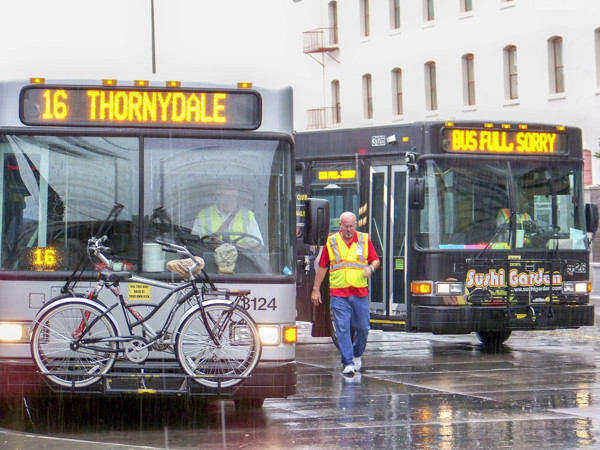
Limited Service During the Strike
Photo by Greg Evans
Because I often ride the bus, I felt dismayed when I heard that Teamsters Local 104, which represents Sun Tran drivers and mechanics, failed to reach an agreement with the city and voted to strike. At first I thought the strike might last a week or ten days – I was here in 2001 when the drivers were out for two weeks, and that was the longest transit strike this city had ever seen – but the Teamsters walkout that began on August 6 is now a month old, with no end in sight.

The hot weather and sharply curtailed bus service have created hardships for many of my fellow bus riders, and I sympathize with them greatly. I also support the union, and I want the Teamsters to get a fair deal from the city. But as I read about the strike in the Arizona Daily Star and the Tucson Weekly, I am struck by the fact that neither city leaders nor company officials want to acknowledge that they have both power and responsibility to settle the strike. Instead they continue to imply that all power is in the hands of Professional Transit Management (PTM, a company hired by the city to manage and operate Sun Tran), which is owned by French-based multinational Transdev. Sun Tran general manager Kate Riley’s opinion piece in the August 26 Daily Star titled “Well-paid Teamsters seek too much from city, Sun Tran,” was little more than an attempt to villainize the Teamsters. On August 30 the Teamsters took out a full-page ad in the Star calling for the Mayor and Council to act like leaders and to settle the strike. The ad made light of City officials’ insistence that they are prohibited by law from getting involved in negotiations with the Teamsters and called for them to “take whatever steps are necessary to ensure that PTM is instructed to bargain in good faith and reach a fair and equitable settlement of the SunTran strike.”

The morning of September 3 the Daily Star featured a front-page article called “Union blasts city/ Sun Tran over effort to bring intemps,” which reported that the City of Tucson had decided to hire out-of-state workers to drive Sun Tran buses while union members are on strike. And as if that wasn’t bad enough, according to a full-page ad taken out by the Teamsters, also in the September 3 paper and their second full-page ad in the past week, the replacement workers are “guaranteed to work 12 hours a day for ‘Strike Pay’ of $21.00/hour straight-time and $31.50/hour overtime, $22 per diem for meals, airfare, and lodging all paid by Sun Tran.” Remember that this is a strike called, at least in part, because Sun Tran refuses to offer the drivers more than $19.22/hour, while entry-level drivers are paid only $13.30/hour.

The Weekly, which has taken a more sympathetic attitude toward the Teamsters, posted a piece online in The Range on September 2 in which Andy Marshall, head of the Teamsters, is reported to have said that Sun Tran confirmed hiring a separate company to take care of placing ads online to hire temporary employees. The Weekly also reported that Sun Tran repeatedly denied these allegations, while city officials continued to insist that they cannot get involved in negotiations between the union and PTM. The Weekly article also noted that “This is an unfair labor practice strike, which means Sun Tran is prohibited from firing and replacing any of the 530 bus drivers, mechanics and others picketing.” Yet the Daily Star reported that replacement workers have been sought, which sounds like an attempt at strike-breaking and union-busting to me.
BRU Members Board the Bus
Photo by Greg Evans
Since August 6, the Bus Riders Union (BRU) has held three events related to the strike, the most recent of which took place on Thursday, September 3, and was billed as the beginning of a “Don’t Pay to Get on the Bus Campaign.” The BRU, of which I am a member, calls for an end to the strike because it hurts bus riders, but the group also supports the Teamsters, opposes union-busting and strike-breaking, and demands that the mayor and council get PTM back to the table to bargain in good faith. The leaflet for the September 3 event encouraged riders and supporters to: "Join us in sending a message to the Mayor and City Council! When you ride, don't put money in the fare box. Take money away from them, maybe this is the only thing the Mayor and the City Council understand? They need to provide LEADERSHIP during this CRISIS, not hide behind the lame excuse that they can't legally do anything. The strike will ONLY be settled with their money and with their strong creative ideas." And in fact there was a well-attended rally at Ronstadt Transit Center, followed by a direct action during which many BRU members boarded a Sun Tran bus without paying.  According to Channel 4 News, “A Sun Tran spokesperson says everyone is encouraged to pay their fare, but drivers have been instructed to let riders board if they refuse to pay during the strike.” BRU member Barbie Urias is shown saying, “Money solves this problem. They got the money. And we’re not going to pay money for these buses until they get those negotiators to agree on something. We need our bus service back.”

Today the Star featured the headline “Nearly half of striking drivers at top salary,” and this article reads like an attempt to rile up public opinion against the Teamsters. It points out that half of Tucsonans, living in a city whose median wage is $32,500, earn less than the $40,000 in pay and $15,000 in benefits earned by top tier drivers. By making an effort to shame the Teamsters into going back to work, the Star shows itself to be unable to process the fact that higher wages will lead to a more prosperous city, though columnists in the same paper have stated that allowing developers to gentrify Ronstadt will somehow lead to a more prosperous Tucson. On July 26, Road Runner columnist Patrick McNamara said that no one should stand in the way of redevelopment of the Ronstadt Center, and he quoted council members and real estate agents who agreed with him. He said, "Keep in mind poverty persists in the region, with Tucson consistently ranking as one of the poorest parts of the country." But this logic isn't applied equally by the Star to the economic needs of working people.

Tomorrow is Labor Day, and the annual Labor Day picnic will take place in Reid Park. Elected officials come to the picnic each year to meet and greet unionists and ask for their support on Election Day. At Reid Park on Labor Day, union members should ask their council members what they’re going to do to restart negotiations and get the buses back on the roads without sacrificing the interests of the Teamsters. And if they don’t have a reasonable answer, they shouldn’t get union members’ votes in November.

[Post Labor Day Note: I was at the Pima Area Labor Federation sponsored Labor Day picnic for an hour and a half on September 7, but I didn't stay long enough to see how unionists reacted to their elected officials. What I said in the above paragraph about the way unionists should cast their votes is my own opinion, and my opinion is not necessarily shared by the Bus Riders Union. Brian Flag posted "Don’t condemn city council for past votes defending poor people, for voting in favor of bus riders" at the Casa Maria blog on Sunday, and he has chosen to emphasize council members' positive contributions rather than the negative ones. I also support the actions of those council members who vote to defend poor people and transit riders, and I certainly don't advocate voting for Republican candidates! I do, however, wish that we had progressive, pro-union third party candidates that we could turn toward when the Democrats let us down.]

[Correction to the statement I made in the first paragraph that the current strike was the longest in Tucson history as of September 6: In an op/ed piece in the Daily Star on September 10, transit historian Gene Caywood said that a couple of transit strikes in Tucson in the 1950s and 1960s lasted more than 40 days.]

Sunday, August 2, 2015

Changes to Tucson’s Ronstadt Transit Center
Should Mostly Benefit Bus Riders


I have spent many hours in transit centers -- waiting for trains or buses, whiling away some time during a layover, or waiting for the arrival of a friend -- and whether I was in Union Station in Chicago or the main train station (hlavní nádraží) in Prague, I’ve watched people striding purposefully along, taken advantage of the shops and cafes on offer, and I've enjoyed the barely controlled chaos around me. Obviously, transit centers are necessary so that travelers can use the washroom, buy something to eat or drink, and find a bench to sit on because sometimes a layover or wait can last for hours, but it seems that the kind of transit center a city needs depends on the range of transit services offered and how long people are likely to have to wait there.

This brings me to the two proposals recently unveiled by developers showing how they would convert Tucson’s Ronstadt Transit Center into a “multimodal transit center,” including apartments, a café and retail outlets, and even a hotel. Why, I ask, would our city want to do that? Ronstadt is a place where the routes of Sun Tran buses converge, and you can go there to catch any bus that travels through the city’s downtown. But at Ronstadt an hours-long wait should never be necessary because, even though Sun Tran schedules are sometimes woefully inadequate, if you are unlucky enough to have just missed your bus on a hot Sunday afternoon, you should never have to wait there more than an hour.

So though it’s nice that the proposals keep Ronstadt situated in downtown Tucson, their notions of the need for multiple uses communicates the idea that the needs of bus riders are simply not important enough to merit a space for themselves. Why does Ronstadt have to be made “multimodal,” and in what way is it an “underutilized piece of land” as city planners have stated? As Greg Evans wrote in the Occupied Tucson Citizen in March of 2013, regarding Bus Riders Union misgivings about proposed changes at Ronstadt:

How it is that a place through which 27,000 people pass daily in our otherwise quiet downtown could be considered “underutilized” explains the union’s concerns: it is underutilized commercially. And this leads us to the issue of it becoming “multi-use.” One could argue that the Ronstadt Center is already multi-use, in that it was designed to be convertible into an open plaza for special public events such as Second Saturdays downtown—which it, of course, is currently being used for.
But, in this case, multi-use means mixing public use with private use, most likely in the form of allowing the Congress Street section of Ronstadt to be developed into retail space.

Evans' article was prescient because, in fact, two and a half years later, the two developers do propose mixing public use with private use.

I have taken a long look at both proposals, and I find something to like about each of them. The Alexander proposal does offer more to bus riders, and except for moving all stops indoors, it would be quite possible to accomplish these goals in the current Ronstadt Center: “Improve conditions for Bus Drivers …[and]… enhance the riders’ experience and provide amenities,” which would include “increased security and safety, indoor waiting area, free Wi-Fi; public restrooms; ticket sales/ customer service; small retail space/ vending machines; change machines; customer service representatives; lost and found storage; transit guides; benches; improved ADA access; and bike lockers.” In fact some of those services are already available, though most of the bus riders I know would appreciate upgraded restrooms and staffing of the Information Booth.

As for the Peach proposal for public spaces, I think the existing Ronstadt Center could easily accommodate Open Space Goals that include "Location for public art; Park-like feel with large trees and grass area; Varied public seating for social interaction; Smaller, flexible space for a variety of passive uses; and Interactive art." But in regard to the private development with retail uses, the residential spaces and the hotel, these developments would only get in the way of people enjoying public spaces and bus riders using public transit. As Greg Evans points out in his recent July 29 article in the Occupied Tucson Citizen, both proposals would push the transit functions of Ronstadt into a very small space that would make the center far less appealing for bus riders than it is at present. And I believe that any changes at Ronstadt should be for the benefit of transit riders first and foremost.

Sunday, July 12, 2015

In Praise of Saving the Planet

I recently read Pope Francis’ new encyclical on climate change, and I was moved by its lyricism, the depth of scientific understanding it displays, and its intensely serious concern for a problem that affects every person on earth. Though I disagree with the Catholic Church’s teachings about some things, I appreciated this strong statement of environmental awareness and its empathy for the poor and dispossessed.

Generally referred to as "Laudato si" (the full title is "LAUDATO SI', mi' Signore" or "Praise be to you, my Lord"), the encyclical is named for a canticle by St. Francis of Assisi. Pope Francis not only shares St. Francis’ name but also his joyful interest in and concern for the natural world. It is notable that this strongly worded admonition to Catholics – and in fact all of us – to do what we can to reverse climate change comes from the first pope to hail from the global South. I also learned on Democracy Now that one of the authors of the encyclical was Cardinal Peter Turkson of Ghana, and understandably "Laudato si" frequently reminds us that climate change will cause the most suffering for the poor and those in the developing world.

The encyclical pays homage to St. Francis of Assisi, who is well known for his canticle that praises Brother Sun and Sister Moon. To some this language seems almost animistic, but the encyclical notes that, “If we approach nature and the environment without this openness to awe and wonder, if we no longer speak the language of fraternity and beauty in our relationship with the world, our attitude will be that of masters, consumers, ruthless exploiters, unable to set limits on their immediate needs. By contrast, if we feel intimately united with all that exists, then sobriety and care will well up spontaneously.” [Section 11]

“Laudato si” is sometimes focused on religious matters, but it attempts to appeal to a wide audience by acknowledging many points of view. For example, it praises participants in the environmental movement and those “who tirelessly seek to resolve the tragic effects of environmental degradation on the lives of the world’s poorest.” [Section 13] Those who are concerned about loss of biodiversity will be glad to read statements like this: “In our time, the Church does not simply state that other creatures are completely subordinated to the good of human beings, as if they have no worth in themselves and can be treated as we wish.” [Section 69] But human beings are given priority and the encyclical clarifies: “Certainly, we should be concerned lest other living beings be treated irresponsibly. But we should be particularly indignant at the enormous inequalities in our midst, whereby we continue to tolerate some considering themselves more worthy than others.” [Section 90]

Sometimes “Laudato si” enters the realm of social ecology as it criticizes "rapidification" or the "more intensified pace of life and work" that we experience in the 21st century [Section 18]. It calls into question our "throwaway culture" that "quickly reduces things to rubbish.” [Section 22] As a result, it says, “The earth, our home, is beginning to look more and more like an immense pile of filth.” [Section 21] Global climate change is seen as a consequence of the intensified consumerist lifestyle enjoyed by those in the developed world, and we are told that this needs to change because "The climate is a common good, belonging to all and meant for all…. Humanity is called to recognize the need for changes of lifestyle, production and consumption, in order to combat this warming or at least the human causes which produce or aggravate it.” [Section 23]

“Laudato si” never loses sight of the twin problems that are its focus: “the cry of the earth and the cry of the poor” [Section 49]. In fact, there are echoes of Naomi Klein’s This Changes Everything as when the encyclical describes our world as one in which “… economic powers continue to justify the current global system where priority tends to be given to speculation and the pursuit of financial gain, which fail to take the context into account, let alone the effects on human dignity and the natural environment. Here we see how environmental deterioration and human and ethical degradation are closely linked.” [Section 56] And everyone is encouraged to be part of the solution: “A change in lifestyle could bring healthy pressure to bear on those who wield political, economic and social power. This is what consumer movements accomplish by boycotting certain products. …This shows us the great need for a sense of social responsibility on the part of consumers. … Today, in a word, ‘the issue of environmental degradation challenges us to examine our lifestyle.’” [Section 206]

Sometimes the language in “Laudato si” is so strong that it calls to mind an ecodisaster novel: “Doomsday predictions can no longer be met with irony or disdain. We may well be leaving to coming generations debris, desolation and filth.” [Section 161]. Catholic or not, serious readers will find it hard to ignore a plea to avoid a future of “debris, desolation and filth,” though even the Pope’s authority is not enough to guarantee success. A change in lifestyle takes commitment and a willingness to "act locally."

For example, using public transportation helps reduce greenhouse gas emissions, and here in Tucson that means riding SunTran buses. But local transit faces a number of financial and logistical problems -- not to mention attitudinal problems, by which I mean that people resist using it. (Interestingly, “Laudato si” addresses both the benefits and problems of public transit as follows:
The quality of life in cities has much to do with systems of transport, which are often a source of much suffering for those who use them. Many cars, used by one or more people, circulate in cities, causing traffic congestion, raising the level of pollution, and consuming enormous quantities of non-renewable energy. This makes it necessary to build more roads and parking areas which spoil the urban landscape. Many specialists agree on the need to give priority to public transportation. Yet some measures needed will not prove easily acceptable to society unless substantial improvements are made in the systems themselves, which in many cities force people to put up with undignified conditions due to crowding, inconvenience, infrequent service and lack of safety. [Section 153]
On July 8, I attended the monthly membership meeting of the Tucson Bus Riders Union where we talked about how difficult it is to get the mayor and City Council to increase transit options in our city rather than cut them. Casa Maria, a lay Catholic Worker community that helps homeless and needy people, is a driving force behind the current Bus Riders Union, and I have seen, again and again, the Casa Maria folks stand up for low-income people, refuse to be intimidated, and consistently fight against throwing poor people “under the bus” as the city decides how to allocate ever-diminishing funds. At the meeting we agreed that appealing to elected officials is necessary, but it is even more important to get more people to come to our meetings, speak about their needs, and stand up to the “undignified conditions” SunTran riders must often endure.

In a recent blog post at the Casa Maria site, Brian Flagg said he was proud to be Catholic as he watched Pope Francis live up to his stated concerns for the poor and the environment. From what I have seen, Casa Maria truly has a similar commitment to answering “the call to solidarity with the poor” that is at the heart of their mission. By nurturing the Bus Riders Union, Casa Maria does more than most of us to help address climate change and its consequences. And anyone in Tucson who cares about the poor and homeless is aware that climate change is here and poor people must bear its harsh realities most painfully. (See “Cruel and Unusual: Closing Downtown’s Parks to the Homeless in a Heatwave.”)

Another lifestyle choice, switching to a plant-based diet, is a solution that is particularly important in a world in which overpopulation is a problem few want to address. Because of the Church’s longstanding opposition to birth control and abortion, I expected that Pope Francis would insist that overpopulation is not the problem. (Here’s what Laudato si has to say about overpopulation: “To blame population growth instead of extreme and selective consumerism on the part of some, is one way of refusing to face the issues. It is an attempt to legitimize the present model of distribution, where a minority believes that it has the right to consume in a way which can never be universalized, since the planet could not even contain the waste products of such consumption. Besides, we know that approximately a third of all food produced is discarded, and “whenever food is thrown out it is as if it were stolen from the table of the poor”. [Section 50]) But many people on the left and in the progressive movement also refuse to cite overpopulation as a major driver of climate change. (See Naomi Klein’s extremely harsh rejoinder to a question about population at a Town Hall Seattle talk she gave last October for This Changes Everything: https://www.youtube.com/watch?v=4b2B-ys3N1o, Minute 44.)

But as the film Cowspiracy shows, animal agriculture is another powerful driver of climate change, and it seems that the more meat-eating humans there are, the less room there is for all the other creatures praised by St. Francis and Pope Francis. In Cowspiracy Dr. Will Tuttle says, "Ten thousand years ago free-living animals made up 99% of the biomass, and human beings only made up 1% of the biomass. Today, only 10,000 years later, which is really just a fraction of time, we human beings, and the animals that we own as property, make up 98% of the biomass and wild, free-living animals make up only 2%. We basically completely stole the world/ the earth from free-living animals to use for ourselves and our cows and pigs and chickens and factory farmed fish, and the oceans have been even more devastated." No amount of praise for the remarkable beauty and diversity of the natural world will bring it back again if habitat is destroyed to make way for factory farms and fields of fodder.

Not only would a turn toward a plant-based diet make make our carbon footprints smaller, it would also end the factory farm system that subjects pigs to gestation crates, hens to merciless crowding and other cruelties which are experienced by billions of creatures every year. (Here’s what Laudato si has to say about animal abuse: “We have only one heart, and the same wretchedness which leads us to mistreat an animal will not be long in showing itself in our relationships with other people. Every act of cruelty towards any creature is “contrary to human dignity”. [Section 92]) When I was a child Catholics abstained from eating meat on Fridays. A re-institution of that practice would help both the planet and the animals, as well as bringing the health benefits of a plant-based diet to more people.

There does in fact seem to be an increased interest in the benefits of veganism, and there is something of a flurry of activity around the plant-based diet in Tucson this summer. The film PlantPure Nation is being shown in Tucson this week. Opening night featured a vegan food court and a chance to buy a cookbook by a local vegan restauranteur, the proprietor of Lovin’ Spoonfuls. We also now have two vegan restaurants downtown -- Urban Fresh and Veg in a Box. Greg and I have eaten at Urban Fresh several times recently, and the food is well-prepared, reasonably priced, and wholesome. In addition, the proprietor and his wife are knowledgeable advocates for plant-based eating, and the vegan meals they offer are fresh and delicious. I only wish that more writers and activists who tell us about the need for lifestyle change to save the planet would advocate veganism.

Thursday, May 22, 2014

Starting My Climate Change Journal


This version of “Other Homes and Gardens,” is a combination of two of my old blogs – “Other Homes and Gardens” and “Fashion Sense by Alice.” Though I have talked about climate change in both blogs (see among others High Water in Prague in 2013), I recently have had the life-changing experience of taking Professor Peter Singer’s Practical Ethics MOOC. This Massive Open Online Course at Coursera (which is still going on) addresses issues like what we owe to the global poor, animal rights, and affirmative action. The section on climate change a couple of weeks ago featured a lecture by Dale Jamieson, whose new book Reason in a Dark Time I’m currently reading. All of this has made me think deeply and seriously about climate change, and  I decided to use this blog as a Climate Change Journal so I can keep track of local and global aspects of climate change and delineate some of the ways I will work to reduce my carbon footprint. I also plan to address the issue of how Climate Change makes the lives of the poor more difficult and dangerous. To help reduce my carbon footprint, I have made the following pledges: 1) To reduce my use of heating and air-conditioning (though I haven’t decided yet how to quantify that); 2) To be a vegan -- at every meal, every day; and 3) To limit riding in a car to two round trips per week.

Here in Tucson I walk a lot, but this city exemplifies sprawl, so I often have to make trips by car or bus. I am one of 1,500 members of the Tucson Bus Riders Union, which in its current incarnation relies heavily on the organizing might of Casa Maria, a Catholic Worker community. The Bus Riders Union has done a tremendous amount to keep the city from raising fares and cutting service. All the members were encouraged to attend Tuesday night's city council meeting, and as you can see from the photo at the CasaMaria site, we showed up in large numbers, wearing our bright yellow Bus Riders Union tee shirts. Organizations that sent representatives included Service Employees International Union, Sustainable Tucson, Derechos Humanos, and Veterans for Peace. As Brian Flagg noted in his post yesterday, the Daily Star failed to mention the Bus Riders Union in its article, "City Council scraps bus changes in budget plan," but there's no doubt that BRU played a major part in the Council's decision to hold off on route changes. Unfortunately, this is just a temporary respite, and the fare increases and route cuts will be back on the City Council agenda in the fall. Which is why Brian Flagg concluded his post by saying, "The time is now to organize bigger and better."


Some Thoughts About the Desert Landscape After Reading Natalie Koch’s Arid Empire and Seeing Sofía Córdova's “Sin Agua”

I wrote this post last spring and never got around to putting it online. Sofía Córdova's “Sin Agua” just closed at the Museum of Contemp...