Showing posts with label East Palestine. Show all posts

Sunday, November 26, 2023

“We Refuse to Die” Is Another Way of Saying “We Intend to Fight” -- Environmental Activism in NE Ohio and SW Pennsylvania

Still from We Refuse to Die video

It’s a chilling statement: “We Refuse to Die.” And it makes an even deeper impression when it’s associated with 6-8 foot wooden sculptures called Externality monuments, which have been carved from a tree killed in a climate-change-fueled Pacific Northwest wildfire. The Externality monument installed in Clairton, Pennsylvania, on November 11 has a haunting face and a resolute expression. (See photos by Mark Dixon.) Melanie Meade, who is a fellow for the Black Appalachian Coalition, now hosts the carving on her land where it can bear witness to the toxic emissions pouring from U.S. Steel's Clairton Coke Works, which is considered to be the worst air polluter in Allegheny County. The Externality monument in Clairton was the first such sculpture to be installed, though there will soon be more of them in the yards of residents in other cities. "We Refuse to Die" is an ongoing campaign to connect communities in Appalachia and the Ohio River Valley to the Gulf South, calling attention to the fossil fuel and petrochemical companies that are polluting the air, land, and water. 

Last year I read about a power outage at the Clairton Coke Works that "required" the plant to flare coke oven gases from its stacks. At the time Matthew Mehalik, Executive Director of the Breathe Project, described the scene as so unpleasant it could stand in for "Sunrise Over Mordor" in a Hollywood film. A Clairton resident said the smell gave her a migraine, but she added, “You have to put up with it or move. There’s nothing you can do. We can’t shut the mill down. We shut the mill down, we’re gonna be a ghost town. We’re already half ghost town." But Melanie Meade, who has since 2011 lost many members of her family to heart conditions and cancer, has a different perspective. She says, "When I first saw the ‘We Refuse to Die’ carvings, I was elated... because this is exactly what the people need. They are unhealed and hurt, and they aren’t even aware that there’s a possibility for hope."  And she adds, “If I’m going to die, it best be for something. So I’m not going down without a fight. We Refuse to Die means you're taking action. You're not going down. We refuse to die when we stand up and say something, when we identify with our pain and speak to what we need to heal.”

The “We Refuse to Die” campaign shows how art and activism can reinforce each other and is currently a part of an exhibit at the Carnegie Museum of Art called "Unsettling Matter, Gaining Ground.” In a pamphlet produced for the exhibit, community activism is referenced on almost every page, and this is certainly true in the discussion between conservation ecologist Nicole Heller and two cofounders of the art collective Not An Alternative, which created the “We Refuse to Die” campaign. They discuss, among other things, the fact that residents often feel that they have to choose between a clean environment and a functioning economy, and they discuss how “art practices” can heal some of the divides in the region. Heller asks, "What kind of resources do we have, specifically to help the community here in Western Pennsylvania talk about climate change and talk about an alternative future? Particularly in Western Pennsylvania because of the long history of being part of the fossil fuel economy. People feel really uncomfortable talking about getting off fossil fuels because it feels like a threat to their own family, their own community, to their neighbor."

Beka Economopoulos, cofounder of Not An Alternative, says, "What we need to be doing is redefining and renegotiating our political alliances so that it is not in terms of left and right, but rather us and them, as in the few who are exploiting the many. Within that frame, I think the proud history of the steel workers and the farmers and the multigenerational communities in Southwest Pennsylvania is something that can be not just recuperated but celebrated, because it casts these communities in the role of hero. Their ancestors participated, perhaps, in one wave of extraction, but even more recently, fought for workers’ rights and brought unions, four-day work weeks, safer working conditions, and OSHA regulations to protect our families and communities’ health. That is what we have to build upon and fortify...”

The “We Refuse to Die” project also offers Toxic Tours, which depart from the Carnegie Museum and take visitors to places like fracking drill pads and petrochemical plants. These tours are led by people in the affected communities and health professionals, and they draw attention to “sacrifice zones,” where people are directly in harm’s way. I'm sorry I missed a chance to go on one of these tours, but during our time in Youngstown last summer, I decided that I wanted to go on a toxic tour of my own. So after we’d been there for a week, Greg drove my friend Kathy and me to some of the places where the environment is being disrupted by fossil fuels and toxic chemicals. We drove past the Shell cracker plant and saw its gleaming metallic pipework--though we didn’t see the nerve-wracking sight of the flaring that goes on there regularly as waste gases burn bright against the sky. We also stopped in East Palestine (I described that visit in my previous post), where we were reminded of the silent and invisible menace that has been haunting that community since the train carrying vinyl chloride derailed on February 3.  And I haven’t forgotten about it since I’ve been back in Arizona.

The Shell cracker plant in Beaver County, PA;
photo by Kathy Wozniak

On November 14, I attended a virtual screening of "Small Town Explosion," hosted by Beyond Plastics and other groups. This short film about the train derailment that took place in East Palestine and the activism it has inspired shows people from the East Palestine Unity Council and other groups fighting the lack of appropriate response from Norfolk Southern and government agencies. Jami Wallace of Unity Council and Daniel Winston of River Valley Organizing are shown speaking eloquently about the "controlled burn" of vinyl chloride and the health problems they have suffered since then, but even more significantly, the film shows them at the Ohio State Capitol disrupting a legislative session as protestors carry signs that say "State of Emergency Now," "Clean Water Now," and "DeWine Declare Disaster." The people chant and hold up their signs, then are evicted from the legislative chamber. They also march to meet with the governor, but he will not see them. Judith Enck of Beyond Plastics says, "I'm really impressed with the activists in East Palestine and also Pennsylvania. They're doing exactly what they need to do, and they need to be really persistent. It shouldn't have to be that way, but that's how things work in the United States of America today on environmental issues." 

It's appropriate that, because these activists continue to stand up for themselves in a way that is commemorated by the sculptures that are part of “We Refuse to Die," an Externality monument is also planned for East Palestine. It will face the tracks on which the Norfolk Southern train passed through town and derailed, causing misery for the town’s residents.

Still from the film Small Town Explosion

Like Judith Enck, I'm impressed with the growth of awareness and engagement in East Palestine, but other places in Northeastern Ohio are experiencing an upsurge of citizen activism, too. Earlier, I described the toxic tour we took during our visit to Youngstown last summer. We ended the tour at the Youngstown Thermal plant, which isn't yet a source of toxic emissions, but threatens to be. It used to be a coal-fired steam heat generating operation that provided heating and cooling for buildings in the nearby downtown. The owner of SOBE Energy Solutions has bought the property and wants to upgrade it in order to turn scrap tires and plastic waste into synthetic gas and to reclaim valuable materials like carbon black, using a process known as pyrolysis. SOBE would then use the synthetic gas to create steam heat for downtown buildings, just as Youngstown Thermal once did. But according to SOBE Concerned Citizens, a group formed to educate people on the dangers of SOBE and to fight against it, pyrolysis can release many toxins into the air, including dioxins, mercury, lead, and benzene. And because the plant is located near student housing, a jail, and other densely populated places, this kind of air pollution would be disastrous.

The Youngstown Thermal plant in July of 2023;
 photo by Greg Evans

SOBE Concerned Citizens has worked hard to inform Youngstown residents, both online and through the use of billboards, about the dangers of pyrolysis. They have appealed to the Youngstown City Council to oppose the SOBE plant and have encouraged residents to send comments to the Ohio EPA. And in a positive move, the City Council has passed a resolution, which though it is nonbinding, opposes the SOBE plant. In addition, the U.S. EPA Region 5 has sent a letter to the Ohio EPA noting that the draft permitting of the SOBE Energy plant raises "potential environmental justice concerns." This is because issuing the permit could violate the civil rights of low income people and people of color who are already living in an area that is heavily polluted. SOBE Concerned Citizens has worked hard, and the City Council and EPA Region 5 have strengthened their position, but it's too soon to tell whether or not the SOBE plant will be allowed to operate. Whatever happens, activists have made their chants of "SOBE, no way!" a memorable part of the ongoing struggle. I sincerely hope that they succeed and that the SOBE plant won't be another stop on a toxic tour in the near future.

Sign opposing SOBE plant at the Dorothy Day House
in Youngstown in July of 2023; photo by Kathy Wozniak

[More about SOBE:  In February Carolyn Harding talked with activists Sil Caggiano and Lynn Anderson about the SOBE plant on GrassRoot Ohio. Caggiano is a retired Youngstown Fire Department Battalion Chief, and Anderson is an organizer for SOBE Concerned Citizens. Note that Anderson is also a retired graphic designer, and behind her you can see some of her music-inspired paintings.]


Friday, October 6, 2023

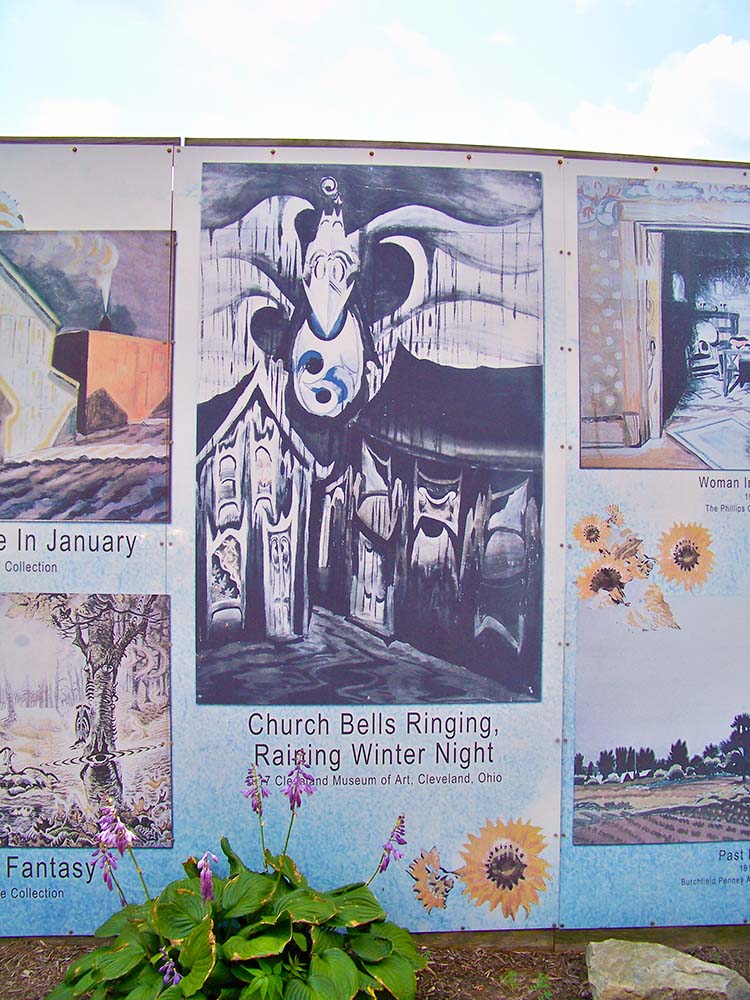
Anxious Overtones: Charles Burchfield’s “Church Bells Ringing” and Differing Attitudes Toward the East Palestine Train Derailment


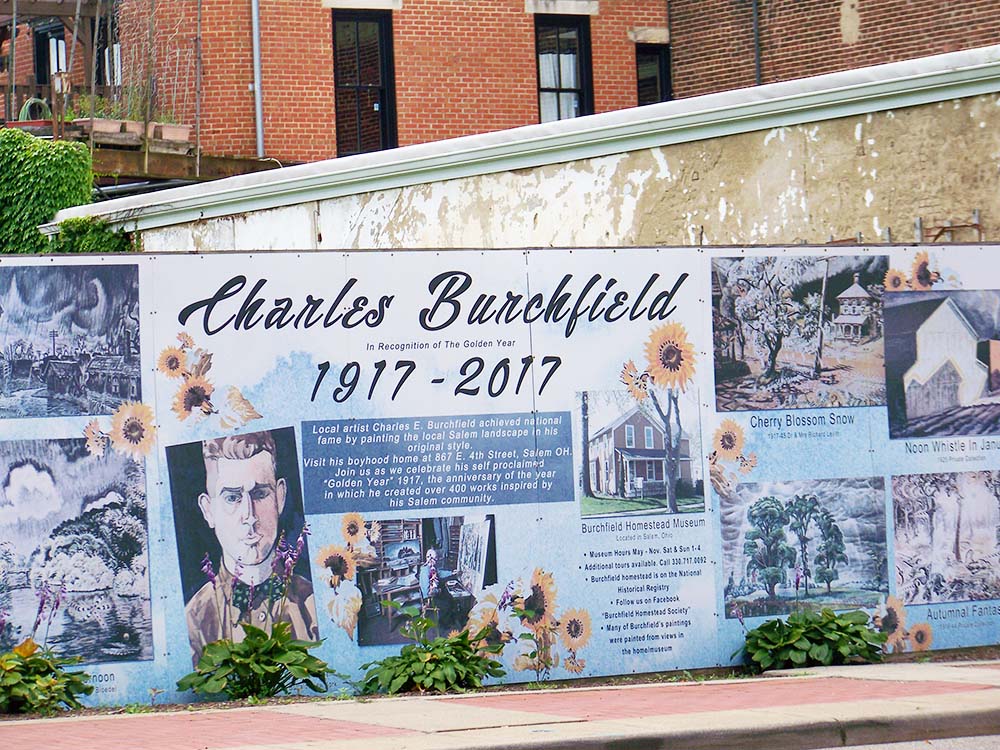
Image at Left: "Church Bells Ringing, Rainy Winter Night" by Charles Burchfield is shown as part of the Burchfield Mural in downtown Salem, Ohio.

In July, during our visit to Youngstown, we spent an afternoon in nearby Salem so we could visit the Burchfield Homestead, a place that memorializes the life and art of the well-known water colorist Charles Burchfield. On the walls of Burchfield’s well-preserved childhood home hang prints of many of his works, especially those from his time in Ohio and from what’s known as his Golden Year of 1917 when he developed his mature style. Burchfield learned to depict the natural world in an intense and celebratory way and to show, both creatively and effectively, the harms human beings inflict on the land. But the image that held my attention that day was “Church Bells Ringing, Rainy Winter Night” because it was in the very house in which we stood that Burchfield had the experiences that led him to paint what is really more a portrait of a mood than of an actual place.

As I looked at “Church Bells Ringing” I couldn’t help but wonder: What is that shape hovering in the space between those two dark houses, slippery in the oily black rain? Does it have eyes and a beak? Does it have wings? And yet I already knew the answers to those questions, that the central image was in fact the spire of Salem's Baptist Church, since destroyed by fire, which when Burchfield was a boy tormented him with its tolling bell. It sounded to him like "a dull roar... dying slowly and with a growl.” He would listen to it on stormy winter nights, and it filled young Burchfield with a sense of dread. (1) The artist added another layer of personal meaning to this work that involved a visual language of Burchfield's own making, in which certain shapes and lines are part of what he called "Conventions for Abstract Thoughts." There were also "audio-cryptograms," which were meant to make visible certain sounds, like the ringing of a church bell.  And so, unlike works such as “Coke Ovens at Night" in which Burchfield depicts harms done to the natural world, "Church Bells Ringing" contains no flames or clouds of smoke, no seared landscapes that would understandably create a sense of alarm. Just two houses, a church and a darkened sky, with the rain falling down. And yet how ominous.

If Burchfield were still alive, had he been around this year when the Norfolk Southern train derailed in nearby East Palestine and sent flames and toxic smoke into the air, he might very well have painted that scene, giving it the sense of urgency and anxiety depicted in his other images of environmental devastation. After all, he worked in Wellsville  and East Liverpool, among other small Ohio towns, so why not East Palestine? But if he had gone back there six months later, his response might have been different. He might have painted something like “Church Bells Ringing, Rainy Winter Night” to show that though the flames and clouds of smoke are long gone, there is still a lot of anxiety and dread in that town, at least for some of its citizens. Only in this case, the sound he might have depicted with an audio-cryptogram would have been the long drawn-out wail of a train whistle.

The Burchfield Mural in downtown Salem

Earlier on the day on which we visited the Burchfield Homestead, we had seen a different image of “Church Bells Ringing." It’s incorporated into the Charles Burchfield Mural in downtown Salem, which commemorates the 100th anniversary of the Golden Year. Right across the street from that mural is LiBs Market, a café space and shop whose owner, Ben Ratner, was an extra in the film version of White Noise, the Don DeLillo novel in which an airborne toxic event ensues after a truck collides with a train carrying toxic chemicals. When we ordered our beverages, I asked at the counter if Ratner was around because I wanted to talk with him about the film and the derailment, but I was told he wasn’t there that day. Nonetheless, I knew, based on an interview he did with CNN, that he's very concerned about the derailment. His house is a mile from the crash site, he and his family were forced to evacuate, and he and his wife are worried about their family's health, the future value of their home and their overall financial security as a result of the derailment.

Knowing this increased the sense of dissonance I felt when, during our visit to the Burchfield Homestead, we spoke with a local woman who told us she didn’t really think there was anything to worry about in East Palestine. She implied that the response to the derailment was overblown, that the creeks (i.e., Leslie Run and Sulphur Run) “had been polluted for a long time,” and that people needed to return to normal. I thought about the things Ratner had said, and I wondered how two people who lived so near to the site of the derailment could feel could so differently about it. But the area near the derailment is in fact a divided community in which some people feel that they aren’t getting the assistance they deserve and continue to experience serious and worrying physical symptoms while others just want to get back to normal. 

Near the site of the derailment in East Palestine, Ohio
July 14, 2023; photo by G.S. Evans

I had wanted to see for myself what East Palestine was like, and so we had made a short trip to the town a few days previously. We stopped the car on  Taggart Street near the railroad tracks, and there was still a crew working on cleanup. We saw signs that said "Road Closed" and called for an identification badge check, but there were few other outward indications of what had happened there. We got out to take a few pictures, and in the one above you can see a dark van. On one side it said, "What's in your air?" and on the back was the notice: "Monitoring in progress." The unfamiliar sight of air monitoring trucks made me feel uneasy, and the fact that there were houses standing so near the place where flames had shot into the sky and a huge roiling cloud of black smoke had erupted gave me a feeling of deep empathy for anyone who had to stay there and still felt sick. I'm always the one who notices the chemicals, who gets a headache or a rash, and in fact after we had been there for a short time I felt nauseated and wanted to move on. Which of course the people who lived in those houses couldn't easily do...

On August 3, a few days after I returned to Arizona, I attended the Virtual Symposium: East Palestine 6 Months After and got to hear four community activists from the affected area talk about the derailment and its aftermath. Each of them described her experiences of the event, as well as the ongoing symptoms she and her family members continue to endure. They also described feeling diminished by the EPA and other government agencies when told there’s nothing wrong with the air and water in their communities.  All four women have worked hard to advocate for testing of air and water and have asked for monitoring of people’s homes, but they all reported that not everyone in the community thinks there are unresolved problems.

Hilary Flint, Vice President of East Palestine Unity Council, said, "We're told that it's safe, and our pushback on that is that safe is very subjective. It's not safe for everyone.” She said standards being used to determine safety are based on OSHA data which usually involves 8-12 hour exposures on men and a single chemical, not multiple chemicals. She added, “So when we're being told that it's safe -- a lot of people, especially initially, believed that, and they said, ‘Oh, OK, it's safe. We'll go home.’ But what they didn't realize was that it wasn't safe for their elderly family member. It wasn't safe for their child with asthma. It wasn't safe for someone like me, a young adult cancer survivor with autoimmune issues. We're told that it's safe, but they can't guarantee that for every single person." 

Asked to give advice to other communities faced with similar disasters, Amanda Kemmer, also of East Palestine Unity Council, said, "Right now the community is so divided between the people who say 'Everything is in your head,' versus those of us who are experiencing symptoms, and... they're really pushing hard with this PR narrative that everything is fine, everything is OK, and they're throwing a ton of money at this. Norfolk Southern is putting millions of dollars... to show that they're trying to 'make it right' but they're doing nothing to help the actual community." 


Halloween decorations in East Palestine, Ohio;
photo by Kathy Wozniak

Nearly two months later, on September 26, in a NewsNation Town Hall in East Palestine, Chris Cuomo focused extensively on the fact that many people continued to feel unwell. When he asked the roomful of attendees how many were still having symptoms, “experiencing things in a way that don't make sense to you physically and that they weren't like that before,” all but a very few raise their hands. Because Halloween is coming up, people in East Palestine were beginning to put up decorations, and Cuomo described the items that resident Shelby Walker had put up on her front lawn. The first is a scarecrow with the sign "Waiting for testing and the truth from Norfolk Southern... and the EPA," followed by a scarecrow with "Still waiting 5 months later," then a skeleton with "Still waiting 8 months later," and finally, tombstones with a sign that says "Too late..." "It's a macabre joke," Cuomo said, "but that's the mentality they have to learn to live with." 

At the town hall they showed a short video of Cuomo's visit to Walker's home, where she talked about the "sweet chemical odor" that permeates her living space and said that one of the derailed train cars was "right in my back yard." When Cuomo asked her how she felt when officials and Norfolk Southern made the decision to do the controlled burn, she said, "I just cried, because I thought... 'I may never have a home to go home to.' Now today I wish that would have been the case. I wish my house would have caught fire that day and I wish I would have lost everything." She said she still has a mortgage to pay and asked who would buy her house now. She said she is now on an inhaler, gasping for breath, and when Cuomo asked her if she and other disaffected residents are just looking for "a paycheck," she said, "Maybe some people are. Maybe they're not. Me, I'm not. I just want to be safe. I want a home that's safe for my kids and my grandkids to be at, and I want health insurance for them for the rest of their lives because we don't know what's going to happen to us in five or ten years." 

Of course, East Palestine isn't the only community where members have had divergent responses to an environmental disaster. According to sociology professor Becky Clausen, community response can vary, depending on the cause of the disaster. When it's an event that could be called a natural disaster, like a hurricane or flood, people tend to support one another and communities pull together. People consider the event to be an "act of God," with no one to blame, and in those cases support and resources often come quickly from outside sources. But in what she calls technological disasters, or "manmade" disasters, like toxic spills, communities become divided. Sociologists call this response the "corrosive community" because of the level of anger, stress, and loss of trust in institutions people experience, especially when support is slow in coming. These findings are based on sociological research on disasters like the Exxon Valdez Oil Spill in 1989. 

Clausen advises people who live in a community where a technological disaster has taken place to "... understand that the reactions you may be experiencing (and those of your friends, family and neighbors) follow similar patterns of social/psychological stress... The confusion and uncertainty about the extent of health-related and economic impacts from environmental contamination create the psychological effect of 'invisible trauma.' Support is often needed to help people move through these reactions and to avoid further social and personal disruption." And yet, as the people quoted above indicate, support has not always been forthcoming in East Palestine, and the sense of corrosive community continues to deepen. 

Clausen recommends setting up events at which people can help each other by listening to each other's stories, and the East Palestine Unity Council and other organizations have facilitated such events. She also recommends learning about similarly affected communities, and the people near the site of the derailment have benefitted from the wisdom of activists like Erin Brockovich and Marilyn Leistner, the last mayor of Times Beach. But when the EPA says the air and water contamination are "below action levels," people who don't have health symptoms may disregard the stories of those who do. And this is where things stand right now in East Palestine.

Adding to the confusion, the differences of opinion about East Palestine aren’t limited to the residents of Columbiana County and nearby Pennsylvania. There have been incidents of victim blaming in the national media, which contribute to the sense of corrosive community. (2) There have been white supremacist accusations that the government is purposefully trying to harm white conservatives in East Palestine. There have even been conspiracy theories making the rounds on TikTok. 

Taken together, all of these things help to explain how people living in the same place at the same time can experience an event and its consequences so differently. But having heard so many residents of East Palestine say they don't feel safe in their own homes and knowing that, as Hilary Flint said, "safe is very subjective," I feel great empathy for those who want continued testing and monitoring. And having been in Charles Burchfield’s childhood home and seen his “Church Bells Ringing, Rainy Winter Night,” I think he might also have had great sympathy for those who don't feel safe in their own homes near the site of the derailment. Perhaps he would have found a way to depict the fear and anxiety that is provoked in the residents of a house standing near the tracks as they hear the insistent hooting of the horn of a train, barreling into town and bringing unknown dangers.
________________________________

(1) According to Nancy Weekly in her description of "Church Bells Ringing" for the exhibition, "A Dream World of Imagination: Charles E. Burchfield's Golden Year,” Burchfield himself noted the “[h]awk-like aspect” of the Baptist Church,” and he "animated the steeple to look like a ferocious bird.” 

(2) Soon after the derailment, Briahna Joy Gray devoted a segment of her show, Rising, to what she described as victim blaming. She began by calling out Joy Behar, who in a February episode of The View "seemed to imply that East Palestine residents brought the disaster on themselves because they voted for Trump." She then showed a clip of Behar, who said, "[Trump] placed someone with deep ties to the chemical industry in charge of the EPA's chemical safety office," then pointed toward the viewers and added, "That's who you voted for in that district: Donald Trump, who reduces all safety…"

As a response to Joy Behar’s comment, Gray played another clip, this time of former Ohio state senator Nina Turner making a more humane assessment on CNN: “For the neoliberals who say that the residents of that area deserve what they are getting, because they voted for President Donald J. Trump, it is abhorrent. This is about poverty. It is about poor, working-class white people who are enduring some of the same things that poor, working-class black people endure whether it's in Flint, Cleveland or Jackson, Mississippi. And so I want to lay it out. That the cultish behavior in politics right now that it is a sin and a shame that when people are suffering to this magnitude that you have people who will fix their mouths, to quote my grandmother, and say that they are getting what they deserve. What they deserve is clean air, clean food, and clean water, they deserve relief both in the short term and also in the long term.”

Not only is Behar’s response not very humane, there’s also more than a hint of schadenfreude about it. Such joy in the suffering of others, especially if they are on the other side in our intensely polarized political climate, seems to be on the rise in our country. A recent article in Scientific American cited a survey experiment in which over 35 percent of liberals agreed with "the idea that those who do not believe in climate change 'get what they deserve' when natural disasters strike them" and 36 percent of conservative respondents expressed satisfaction "when those who support restrictions on how businesses operate during the pandemic lose their job because of government regulations." The authors of the article say, “Such 'joy in the suffering' of partisan others threatens to dramatically alter the U.S. political landscape,” and it also threatens to make it difficult for people to get the help they need when they are afflicted by an event, like the East Palestine derailment, over which they had no control. 


Wednesday, August 9, 2023

An Ekphrastic Look at Monet’s Gare Saint-Lazare and Our Recent Amtrak Trip


Arrival of the Normandy Train, Gare Saint-Lazare (1877). Public Domain
Oil on canvas, 60.3 × 80.2 cm (23.7 × 31.6 in). Art Institute of Chicago

Our Amtrak trip from Tucson to Chicago last month was marked by a lulling rhythm-of-the-rails state of mind that allowed us to sleep even when the train whistle hooted all night long. The food is really pretty good and was made even better by the constantly changing views of the countryside that slipped by as we ate. We could see New Mexico skyscapes along the Sunset Limited portion of the trip, and later we had a chance to look over all those Texas towns we’ll never visit during the 24 hours the Texas Eagle spent in its namesake state. The transition from the West, with its calm arid landscapes, to the East with more grass and trees and population density, is always worth commenting on when you wake up 48 hours into the trip and see the Mississippi River and St. Louis’ Gateway Arch.

Of course, along the way, we experienced the frequent, low-level frustration of being kept motionless as freight trains passed our train, leaving it shuddering in the wake of one of Union Pacific’s rude giants. (Amtrak says that for more than 50 years freight railroads have, by law, had to give Amtrak "preference" to run passenger trains ahead of freight trains, but freight lines tend to ignore the law and it's hard for Amtrak to enforce it. This gives the Sunset Limited an on-time performance of only 19%.)


Amtrak in Benson, AZ 
https://www.flickr.com/photos/petegregoire/, CC BY 2.0

We also had a much longer delay just outside Chicago when there was an accident at a poorly marked crossing, and I thought the day-long layover we had set up for ourselves in the Loop might evaporate altogether. That’s why when we finally made it to the Art Institute, and I was standing before “Arrival of the Normandy Train, Gare Saint-Lazare” as a kind of appetizer before I made my way to the room that’s filled with Monets, I enjoyed my fellow-feeling with the artist, who also loved trains, and I felt a little bit superior to him because he loved those dirty steam engines that clouded up the sky, whereas modern diesel trains are much cleaner (and electric trains are even more so). I also now know something about Monet that I didn't know back in the 1960s and 1970s when, feeling privileged to be at the Art Institute, I would stare for hours at all the impressionist treasures I could wrap my gaze around.

Claude Monet, as it turns out, was a connoisseur of the industrial smog of late nineteenth and early twentieth century Europe and London. According to a recent study, the thick smog of the early Industrial Revolution may have inspired Monet (and British painter JMW Turner, whose work was also included in the study) to depict the world, as the title of the ARTnews article about the study has it, as though in a "dreamlike haze." Anna Lea Albright, coauthor of the study, told CNN that, as air pollution levels increased, “The contours of their paintings became hazier, the palette appeared wider, and the style changed from more figurative to more impressionistic: Those changes accord with physical expectations of how air pollution influences light.” Not everyone agrees with this -- Sebastian Smee, art critic at the Washington Post, disagreed with the study's authors that the creation of Impressionism could be explained so simply, but even he doesn't doubt that "Monet was responding to an increasingly polluted environment." 

The painting of Gare Saint-Lazare at the Art Institute is dated 1877, and according to Jean Renoir in his biography of his father, Monet not only worked to emphasize and celebrate smog and fog in his paintings of the station, he even talked the stationmaster into stopping the trains for the best composition and stoking them up so they would produce even more smoke. In spite of the industrial intensity of the scene in this painting, however, the palette is soothing: blue, gray and white predominate, except for the greenish station floor. According to the museum label, this work is darker and less abstract than later works, giving a fairly clear view of the station, the approaching train, the glass-paneled roof and the buildings in the background. Yet there's something cool and dreamy about the scene itself, in spite of the steamy sky and the approach of a gigantic machine, maybe because there's still some space in the foreground from which we watch the train. It’s as though the excitement that Monet must have felt about the huge energy of the train as it moved so many people and barreled its way into the station was outweighed by his appreciation of its beauty. We now know that those steam engines weren’t very good for the environment, and the passengers must have experienced harmful levels of smoke if they sat in cars with open windows. But Monet considered them to be a feast for the eyes, if not for the other senses.

Our own decision to take the train on our trip east this summer had mostly been a matter of convenience, but we also wanted to be more environmentally friendly than we were on last year’s car trip. Was that the case? Greta Thunberg travels by train, which is something of an endorsement, and according to the same BBC article in which I learned about Ms. Thunberg’s travel arrangements, train travel "virtually always comes out better than plane, often by a lot.” Unfortunately, diesel trains' carbon emissions are as much as two times those of electric trains, and of course Amtrak trains are diesel-powered. But according to the Amtrak website, “rail travel produces up to 83% fewer greenhouse gas emissions than driving and up to 73% fewer emissions than flying, making Amtrak the best option to shrink your travel carbon footprint.” They also say, “According to the 2021 U.S. Department of Energy Data Book, Amtrak is 46% more energy efficient than traveling by car and 34% more energy efficient than domestic air travel.” 

And not only is travel by rail a greener option, it has other benefits as well. We like to read and write and daydream, and a long train trip is a good chance to do all those things. Our trip was a relaxing experience, for the most part, but I admit that I also felt some anxiety on the trip because I know sharing the track with freight trains can have hazardous consequences. Later, while visiting friends in Youngstown, Ohio, we made a brief visit to East Palestine, the site of a Norfolk Southern train derailment, where there was a “controlled” burn of five boxcars of vinyl chloride and the spread of harmful chemicals throughout the area. Six months later, the cleanup is still ongoing, and area residents are still worried about health consequences. (See this opinion piece at The Hill by E. Palestine resident Misti Allison.)

In a recent article at NPR called "After the East Palestine train derailment, are railroads any safer?" Erika Ryan reported that, though there used to be a four-person crew on a freight train, over time, crew members like flagmen were considered unnecessary. The freight industry now wants trains to have one worker on board: an engineer, in spite of the fact that there’s been a move toward longer trains, some of them three miles long and maybe more than 20,000 tons. Ryan also said that the freight industry's business model, known as PSR (precision scheduled railroading), which was meant to make the trains run more efficiently, has resulted in large numbers of layoffs, and, "Freight workers across multiple class I railroad companies have told NPR that nearly every aspect of their job has changed as a result of PSR -- including reductions in time dedicated to locomotive maintenance, inspections and training." As a result, these workers said that derailments like the one that took place in East Palestine were inevitable. And even in East Palestine, there's still lots of freight traffic. At one point when we were there, two behemoth freight trains passed each other, travelling in opposite directions, holding up traffic and making an intense amount of noise.

Railway ticket for the Texas and Pacific Railway. The trains were designated as
"Eagles"--Texas Eagle, etc. Circa 1950s. Public Domain.

The pitch and duration of a train whistle make it a mournful sound, one which we heard many times on our Amtrak trip, and stories about derailments and so-called bomb trains gave anxious overtones to those sounds. It made me even more uneasy to learn that there is only one human being on those freight trains, and that person is charged with making sure nothing goes wrong. How can a small flesh and blood person keep track of three miles of diesel-driven metal, weighing many tons? It is the hubris of the rail companies that makes it possible for them to think this is possible, and each time a huge train raced past our Amtrak train, I thought about how hard that lone engineer’s job must be. As I write this and I look again at an image of Monet’s Gare Saint-Lazare painting, I remember that, although the train in the painting was a steaming, roaring monster, at least there were enough human beings around to bring it to heel so Monet could paint it as he chose.

Some Thoughts About the Desert Landscape After Reading Natalie Koch’s Arid Empire and Seeing Sofía Córdova's “Sin Agua”

I wrote this post last spring and never got around to putting it online. Sofía Córdova's “Sin Agua” just closed at the Museum of Contemp...