Saturday, October 22, 2022

The Luis Gutierrez Bridge Spans the Santa Cruz River Gracefully; It Also Links Two Parts of a Divided Community and Makes Connections to the Past


The Luis Gutierrez Bridge,  with art by Brenda Semanick and David Johnson Vandenberg, in collaboration with architect David Dobler of Structural Grace, the Tucson engineering firm that designed the bridge.


It was a little after 8:30 on October 14 when Greg and I hurried toward the Luis Gutierrez Bridge on the West side of Tucson. The morning sunlight was dimmed by a thin, high layer of clouds. Usually that’s a good thing in our sun-drenched city, but on this particular day we wanted to witness a solar art event, so we really had hoped for full sun. I glanced at the sign that greets pedestrians as they walk onto this multimodal bridge (which also serves cars, buses, a streetcar, and bicyclists), and I noticed that it said, "If our glorious sun is shining," we might witness an event "that those perceptive, those interested, those who appreciate symbolism, will experience only once a year in those few moments." We were joined by five other people who had come to the bridge on the discovery date and time indicated, but the sun didn't come through for us and the sunlight-formed image that might have aligned with a second image on the sidewalk below never quite appeared. The seven of us stood there for a while, hopeful, but the sky was just too cloudy and the October sun wasn’t bright enough. The others wandered off, and Greg and I took a few pictures and groused a little about the sun’s poor showing. Even so, we agreed that it was still worth our time to have hurried out to the bridge on a pleasant fall morning because the Luis Gutierrez Bridge is a very impressive structure.


The sign that greets pedestrians on the Luis Gutierrez Bridge.

As the sign on the bridge suggested, I’m a person who appreciates symbolism, and bridges are often symbolic structures. This one is subtly and especially so. Once called the Cushing Street Bridge, the Luis Gutierrez Bridge can be seen as a symbol of connection as it links two parts of a divided community that was split apart when Interstate 10 was built. What makes the bridge a particularly appropriate structure for Tucson is that it is a work of solar art, which is also what enables it to create links to the past. At twelve precise times each year, the sun shines through laser-cut images on one or another of the shade canopies that extend over the bridge, and an image formed by the sun’s light aligns with another image embossed onto the sidewalk. We were there on October 14 because the solar projection of the Tucson Pressed Brick Company’s stamp is supposed to align with an image of the brickworks on the sidewalk. October 14 was one of the twelve dates selected by a community ballot, according to the bridge’s designers, because it is the date of Quintus Monier’s death. He was the architect who founded TPBCo, and his achievements included building the St. Augustine Cathedral. He died in 1923. 

Tucson artist Brenda Semanick, who died nearly a hundred years later in 2019, designed the canopy panels that project images onto the sidewalk; she also designed the leaves that perforate those panels (and are embossed on the sidewalk as well) and the bats and other clay creatures that decorate the pier that holds up the bridge. Her artist husband, David Johnson Vandenberg, drew the sidewalk images. In turn, the couple collaborated with architect David Dobler of Structural Grace, the local engineering firm that designed the bridge; it was Dobler who made sure that the sun lines up with the images on the dates and times listed. (See 
http://www.zocalomagazine.com/solar-art/) All of this painstaking work is what makes the Luis Gutierrez Bridge such memorable public art. In fact, it was named by Roads and Bridges magazine as one of America’s Top Ten Bridges in 2012. 

Leaves embossed on the sidewalk of the Luis Gutierrez Bridge.

If you stand on the bridge and look down over the railing, you won’t see much of the Santa Cruz River, which the bridge was built to span; in fact, most of the time there’s no water down there whatsoever, just some vegetation and a great deal of bare ground. These days the Santa Cruz River only flows through Tucson because of human intervention – here in the desert southwest the groundwater has been pumped so extensively that the river can’t flow unless effluent is released into the riverbed.  That effluent has helped make some parts of the riverbed green and has created a home for some native fishes, but the Santa Cruz has nearly disappeared in most of the Tucson area.  Over the past hundred years, you could say that the river has been effaced by the activities of a growing city and the influx of new Anglo residents. It seems this is also what happened to the nearby neighborhood.

When the Luis Gutierrez Bridge was opened to pedestrian traffic in 2012, former City Manager Gutierrez said, “The people who have lived in the West side of our community have for generations felt that when the freeway was constructed that they became separated from the community.” (Note that the freeway can clearly be seen from the bridge.) He added that the bridge provides a way for the community to be reunited.  Expanding on that, Brenda Semanick talked about the bridge as “…a span across time that reaches to our past.”
This was brought home to me in a gentle but insistent way as we stood on the bridge on October 14. I realized that the period of time during which the Tucson Pressed Brick Company was located not far away from the bridge – that is, between 1894 and 1963 in the area south of Congress Street and west of the Santa Cruz River – was also a period of time during which there was a non-stop effort to change Tucson’s identity from that of a city with strong Mexican influences and important Mexican and Mexican-American populations to a city dominated by Anglo culture and people. Or as Lydia Otero says in their book In the Shadows ofthe Freeway: Growing Up Brown and Queer, “Race and place became intertwined early in Tucson’s history.”  (Otero, In the Shadows of the Freeway, p. 24)

I had heard
former UA professor, historian, and Tucson native Otero read from their book at a National Writers Union event in September. I wanted to hear more of Otero’s story, so I looked at their website. Here’s the way In the Shadows of the Freeway is described there: “The author witnessed how the steady expansion of Interstate 10 (I-10) separated and isolated a barrio of brown and poor residents from the rest of the city. Growing up 200 feet from the freeway meant more than enduring traffic noise and sirens for Otero and other barrio families. It introduced environmental hazards that contributed to the death of family members.”  Based on Otero's reading, my experience on the bridge, and this compelling description, I decided to buy the book.

Because Otero's work is filled with serious depictions of human suffering brought about by conditions that prevailed during the time they were growing up, it might seem strange to focus on building materials as I intend to do in the rest of this post. But the book is also about the way a neighborhood was destroyed as the freeway and convention center were built, so building materials are very much a part of 
the story. In the first chapter Otero talks about their neighborhood with great affection, but with an acknowledgement of some of the negatives as in the following description: “When I call up my earliest memories, I think of dirt. We lived in a house surrounded by a yard of dirt, and our house was built of adobe blocks that my mother and her sisters had constructed with their own hands. We lived at the intersection of unpaved roads, and when cars drove by, at whatever speed, they created clouds of dust that eventually found its way into the house and into my hair, skin, eyes, and sometimes teeth.” (Otero, In the Shadows of the Freeway, p. 6) The image of the dust finding its way into hair and eyes and teeth is a strong and troubling one, and it makes you wonder why the city didn’t do something to dampen down those clouds of dust. However, also embedded in that quote is a more complex and benign role for the dirt, which involved hand-made adobe blocks that were used to build the house. Otero cites the relationship between the dirt beneath their feet and the house in which they lived, and in fact many homes in Tucson were built of adobe blocks – or bricks – made from clay and mud, especially in the part of the city where Otero lived.

In another of Otero’s books, La Calle: Spatial Conflicts and Urban Renewal in a Southwest City , they showed the ways that building materials in Tucson changed as Mexicans and Mexican Americans were being displaced. Otero stated, "In 1883, practically every building in Tucson was made of adobe, and it remained the primary construction material for Mexican Americans well into the first half of the twentieth century,” but they quote architects Anne M. Nequette and R. Brooks Jeffrey who say that architecture was used to express Tucson's "American" identity. Otero goes on to say: "Anglo Americans intentionally began to build their structures in styles and with materials that marked them as distinctive. These new forms also served to assert Anglos' spatial and social dominance. Brick replaced adobe (emphasis mine) as Tucson moved 'well on its way toward developing the appearance of an American town.'" Beginning in the early 1880s, according to historian C.L. Sonnichsen, "Brick and lumber were in; adobe was out" for Anglos in Tucson. (Otero, La Calle, p. 47)

But Tucson was a growing city and because adobe was deprecated by the new Anglo arrivals, when the Southern Pacific Railroad arrived in 1880 (another of the events commemorated on the Luis Gutierrez Bridge), Tucson builders began to use lumber and bricks brought in from El Paso and Los Angeles. By the late 1800s brick became the preferred building material, and in 1896 architect Quintus Monier founded Tucson Pressed Brick Co., or TPBCO, located below Sentinel Peak at 800 W. Congress St., a few blocks from the current location of the Luis Gutierrez Bridge. Monier used bricks produced there in the building of the St. Augustine Cathedral in 1897 and in the Santa Rita Hotel. The company produced both pressed bricks and firebricks, and the sand along the edge of the Santa Cruz River was used to temper the bricks and the clay was taken from the Santa Cruz floodplain

Image of brickworks and text on the Luis Gutierrez Bridge.

Though the Congress St. location of TPBCo has been closed since 1963, Michael Diehl of Desert Archeology, Inc., not only excavated the brickyard but also interviewed people who worked there and lived nearby.  In an article called "The Tucson Pressed Brick Company at Work and at Rest," he described the process of making bricks at TPBCo, which was more of an industrial operation than the process of making adobe blocks had been. Though materials were sourced locally, such as clay from alongside the Santa Cruz River and "red shale" from the hills near Kennedy Park, machines were an important part of the process – there was a two-story mixing and grinding machine known as a "pug mill" and scove kilns for firing bricks. The workers interviewed by Diehl were not represented by a union, though the men described their difficult work as better than cleaning molybdenum-bearing mud from equipment at Pima Mine or doing agricultural work. "It was nice work making bricks," said Henry Machado, one of the TPBCo workers. "It was nice because I got out of the cotton fields working like this [indicates hunching]." (Diehl, p. 177) Undoubtedly, the racism inherent in the work life of a Mexican-American laborer of the time contributed to this positive attitude toward the hard work at the brickyard, but Diehl does describe a strike that took place in the 1940s during which the company at first tried to replace the men with scabs, but then, "After one day of chaos, the expertise of Frank Rodriguez Sr. and his other colleagues was recognized and rewarded with an increase of two bits. The next day all the regular brickyard men were back on the job." (Diehl, p. 177)

Diehl also interviewed Adela (Varelas) Mejias, who lived near the TPBCo, and she described helping her mother wash clothes in boiling water because when her father came home from work, his clothes and skin were covered in red brick dust. And even after the dust was washed out of the clothing, it had to be hung to dry and was often covered again by red brick dust given off by the kilns. (Diehl, p. 180) This assault by dust was similar to what was happening to Lydia Otero’s family in the shadows of the freeway not far from where TPBCo operated.

As I read In the Shadows of the Freeway, I found other references to bricks and adobe that deepened my understanding of what happened in that part of Tucson. Most surprisingly, the adobe that was once so deprecated is now worth a lot of money. Otero describes walking through the streets of a neighborhood where their mother once lived and realizing that though their mother, who was a low-paid maid, was able to rent an adobe house there, a university professor like Otero couldn’t afford to live there. Otero says, "Now the area is dominated mostly by white families willing to pay hefty sums of money to live in adobe homes with a history. Since the 1980s the property where my mother once lived has sold five times. In 1986, the house sold for $25,000. Ten years later, a new owner forked over $325,000. In 2012, it soared even higher, netting $516,000. After the house was subdivided, one apartment is currently worth $262,900." (Otero, Shadows of the Freeway, p. 45)  It's clear that Tucson is no longer a city where brick is much preferred over deprecated adobe; it has again become a place where old adobe buildings have great cachet and desirability. Because I've never been in the market to buy a house in Tucson, I wasn't aware of this shift in values, but it's clear to me now that even building materials can have cultural and political significance. 

Not only did Greg and I have a memorable morning out on the Luis Gutierrez Bridge, but I can honestly say that the bridge provided me with a true link to the past, as it inspired me to read Lydia Otero's book and learn about crucial aspects of Tucson's history that I had never known of.

Monday, September 26, 2022

A Fifth and Final Ekphrastic Essay About Our 2022 Road Trip: the Prairie and the Dust Bowl


Erosion No. 2, Mother Earth Laid Bare by Alexandre Hogue

When Greg and I were planning our 2022 road trip, our goal was to visit friends and family in Ohio and to investigate some places of interest there, but we also wanted the trip itself to be as full of memorable experiences as possible. One of the most significant things about our journey, it seemed to both of us, was that we would be passing through a swath of the country that had been most deeply affected by the Dust Bowl back in the 1930s. We already knew about the environmental devastation that had been visited on this part of the country because of the destruction of the prairies and the use of bad farming practices, and we hoped to learn more about the Dust Bowl and see remnants of the few acres of prairie that are left. Greg brought along a jump drive on which he had loaded lectures and audio files from books that were relevant to this and other sights we hoped to see, and we listened to them along the way.

On the eastbound trip, once we left New Mexico, we drove across the Texas panhandle, spent the night in Amarillo, then continued across Oklahoma. In Tulsa, we stopped at the PhilbrookMuseum of Art, which has exceptionally beautiful and artfully landscaped grounds. There we saw “Erosion No. 2, Mother Earth Laid Bare” by Alexandre Hogue. At the museum, I stood for a long time in front of this painting in which the outline of a woman's body is etched into and formed from the dry and desiccated soil. Her face is veiled and her lower legs and feet cannot be seen, but otherwise the form of a mature woman's body is represented in the loess-like soil as she sinks into and is surrounded by the severely eroded land. In the distance a small, dilapidated house can be seen, along with a bare tree and a small strip of grass. The house looks abandoned, the land looks depleted, and a viewer might wonder what it was that happened here – unless they knew that in 1936, the date given for this painting, the Dust Bowl was well under way. In the foreground, Hogue carefully depicts one of the causes of the problem, one of the reasons why Mother Earth's body is deprived of the vegetation that once would have covered it and is exposed in such an undignified way.

In the foreground is a steel plow, the sod buster, with its curved moldboard that lifted the sod and turned it over, making it possible for farmers to break through the dense and complex root systems that prairie grasses send down into the earth. The prairies of North America were systematically "broken," that is, turned into farmland, after European settlers arrived. Beginning in the 19th century, various new and efficient types of farm equipment were used, as well as new high-yield seeds and artificial fertilizers, to grow corn and other crops on the land that was once grassland, but the first and most important step was the breaking of the sod, a task the steel plow was designed to do. As a result of these activities, the grasslands of central North America have been reduced by 79% in the past 200 years, and in some places by 99.9%.  All of the grasses and other plants that once formed the prairie ecosystem and made the land so fertile also held the soil down with their roots, and that's why, when this cover was removed by farmers and when drought struck, there was a surprisingly complex yet altogether predictable eco-disaster waiting to happen. We now refer to it as the Dust Bowl.


Farmer and sons walking in the face of a dust storm. Cimarron County, Oklahoma, USA by Arthur Rothsetin, April 1936. This image is a work of an employee of the United States Farm Security Administration or Office of War Information domestic photographic units, taken as part of that person's official duties. As a work of the U.S. federal government, the image is in the public domain in the United States. This image is available from the United States Library of Congress's Prints and Photographs division under the digital ID ppmsc.00241

While we were driving through Oklahoma, we listened to the first few chapters of The Grapes of Wrath, and I was impressed by the solemnity with which Steinbeck described the terrifying changes in the land that had been brought about by 1930. The opening chapter is a description of drought-afflicted Oklahoma, and listening to it helped us to imagine what the landscape might have looked like then. Farmers in Oklahoma, and throughout the North American grasslands, had been told that "rain follows the plow," and so many of them were not prepared when an earlier period of plentiful rain gave way to a period of intense drought. The topsoil was exposed as crops died, and it was reduced to a powdery dust. What Hogue depicts in "Mother Earth Laid Bare" is the stage on which the Dust Bowl took place, but The Grapes of Wrath focuses on the human consequences of that event. Steinbeck describes the day after strong winds blew across the fields, darkening the sky with dust:

"The dawn came, but no day. In the gray sky a red sun appeared, a dim red circle that gave a little light, like dusk; and as that day advanced, the dusk slipped back toward darkness, and the wind cried and whimpered over the fallen corn.

"Men and women huddled in their houses, and they tied handkerchiefs over their noses when they went out, and wore goggles to protect their eyes." (The Grapes of Wrath, page 5)


And this was only the beginning of an ecological catastrophe that drove three and a half million people out of Oklahoma and the other affected states. 

Of course, many of those people survived the Great Depression, and both the U.S. economy and the life of U.S. farmers later improved because of the New Deal (and World War II, sad to say). But what about the prairie? The future of that ecosystem and the plants and animals that depended on it continued to be a story of disappearance and loss. Most of the prairie land is gone now, and many people react casually to this fact: It was just grass and empty land, so why does it matter? But grasslands are among the most biodiverse areas on the planet, and in a world that’s in the middle of the sixth great extinction, this rich ecosystem is important. In addition, many of the Native peoples of this continent had a way of life that was deeply intertwined with the prairies, and when the buffalo were slaughtered and the plains were transformed to farmland, many Native Americans’ way of life was threatened as well.  

So what are the prairies like today? After we visited the Philbrook Museum in Tulsa, Greg and I headed to Missouri and stopped at Prairie State Park to get a small experience of the prairie ecosystem. Our time was limited, and we weren’t able to go to the visitors’ center; we just parked the car and walked out into the prairie. The air smelled like the essence of sweet grasses and wildflowers. There were swallows overhead and lots of flying insects. We knew there were wild bison around, but we didn’t see them -- just a rich mix of plants and many birds and butterflies. It was early July, so the grasses had grown waist-high in many places, but because this is tallgrass prairie, some of the grasses eventually will get to be eight to ten feet tall. The sounds of birdsong and buzzing, trilling insects made gentle music, and there was a light wind.

In a video we watched before the trip, naturalist Dana Hoisington says the park is the largest piece of preserved prairie in the State of Missouri. A third of Missouri was once tallgrass prairie; now it’s less than 1/2 of 1%. Hoisington says that prairies and grasslands are among the most endangered ecosystems on earth, and he describes many of the plants and animals that live in the park. He also talks about the Osage people who once regularly passed through this area and who depended on the bison for their food and other needs. By the late 1880s, Hoisington notes, there were fewer than 1,000 bison in North America, whereas before the European settlers came, there were as many as sixty million of them. He also says that prairies are worth preserving for their inherent qualities, and he adds, “There's so much natural beauty, but it takes a little different mindset to appreciate it…” After we had been at Prairie State Park for a while, Greg and I were most definitely of that mindset.

On our westbound trip, after we had spent time in Ohio, we wanted to expand our prairie appreciation, so we decided to go to the Tallgrass Prairie National Preserve. Once we began to get closer to Kansas, we listened to an episode of the BBC series "In Our Time" about the American Populists. This 19th century movement in Kansas and other Midwestern and Southern states came about because farmers were really suffering from drought and they were also plagued by low prices for their crops and extreme isolation. As a result, a few decades before the Dust Bowl, farmers formed a Populist Party, and their candidates won many offices, both state and national. The fact that U.S. currency was backed by the gold standard was considered by William Jennings Bryant and other populists to be responsible for the low prices farmers faced, so the populists opposed the gold standard. If not for the ways racism was used to turn poor white farmers against poor black farmers, the Populist Party might have had a much greater influence on American politics. Toward the end of the episode, presenter Melvyn Bragg asked if it's true that The Wonderful Wizard of Oz is an allegory of the Populist era. His guests agree that this is probably true, and as in any allegory, the characters and settings have hidden meanings beyond the overt ones Baum assigns to them in the story. The scarecrow, from an allegorical perspective, represents the American farmers; the tin woodsman the American workers; Dorothy the average American; and the Cowardly Lion is said to represent the politician William Jennings Bryant. 

After we heard about the Populists, Greg and I listened to a couple of chapters of The Wonderful Wizard of Oz. Though most people know it as a children’s story made into a movie starring Judy Garland, The Wonderful Wizard of Oz has a complex and interesting connection with the American prairie. In fact, the first sentence of the story is: "Dorothy lived in the midst of the great Kansas prairies, with Uncle Henry, who was a farmer, and Aunt Em, who was the farmer's wife." And not only does she live on prairie land that has been “broken” and turned into farmland, but she lives in a world strangely similar to the one depicted by Hogue in "Mother Earth Laid Bare." Baum says that when Dorothy stands in the doorway of the house she shares with her aunt and uncle and looks around, "...she could see nothing but the great gray prairie on every side. Not a tree nor a house broke the broad sweep of flat country that reached the edge of the sky in all directions. The sun had baked the plowed land into a gray mass, with little cracks running through it. Even the grass was not green, for the sun had burned the tops of the long blades until they were the same gray color to be seen everywhere." It is from this harsh world that Dorothy and her dog Toto are swept up by a tornado and carried to the land of Oz. The wind, although not personified in this fantasy, is an actor in the story, just as it was in the Dust Bowl when it carried the loose soil skyward to block the sun and drove people from their homes.

By the time we got to the Tallgrass Prairie Preserve, we were pretty psyched about what we hoped to see there. Unfortunately, though the Preserve's website describes this as the place where "the tallgrass makes its last stand," we didn't have the kind of transformative prairie experience here as we did at Prairie State Park in Missouri. As before, our time was limited, but the areas that were accessible to us didn't have the kind of lush grass and plentiful bird and insect life that we found in Missouri. As far as the eye could see, the grass was short like a somewhat overgrown lawn, and we couldn’t see any bison. We speculated that this is in part because Tallgrass Prairie National Preserve is regularly burned and allowed to regrow so that cattle can graze on it. As we stood near the old schoolhouse and looked around, we felt that this land no longer had the heart and soul of the prairie. But at least our trip to the preserve and later our drive through the Flint Hills gave us a view of Kansas grasslands.

So is it possible that we could have another Dust Bowl? According to an October 2020 article in Smithsonian Magazine, the answer is yes. Author Alex Fox cites a study that shows that dust levels have been rising, as much as 5% per year, and this trend coincides with hotter and drier weather due to climate change and a 5-10% increase of farmland in the Great Plains. These conditions mimic those that led to the Dust Bowl, and researchers say there’s no reason such an event couldn’t happen again. And if there is another Dust Bowl, Hogue’s “Mother Earth Laid Bare” is a grim reminder of what human beings and other living things will have to face.

Saturday, September 24, 2022

A Fourth Ekphrastic Essay About Our 2022 Road Trip: Ways of Making Steel


Riverbank, Steel Mills by Al Bright 

While we were in Youngstown, as we drove around to look at the city, I was very much aware of a notable absence: the conspicuous lack of the steel mills that once lined the river. Those mills, when they were still in operation, affected our surroundings enormously, added grit and sulfur to our air, lit up the sky at night, and drove every living thing from the river. Now the mills are gone (except for the Vallourec Star plant, a latecomer), and so are the sounds of train cars coupling in the night and the smoky mill town atmosphere.

Since my last visit to Youngstown, my creative essay about the Mahoning River was published. It’s called “A Dozen Images Made in or Near Youngstown, Ohio, That Show Why People Need Both Jobs and Fish,” and while I was working on it, I spent a lot of time looking at art made in and about Youngstown and thinking about the days when we called the Mahoning Valley the Steel Valley. (Those were also the days during which the Mahoning River was considered by some to be the most polluted river in the United States.) Among the art works and photographs that I really wanted to include in my essay was a painting by Al Bright, not because his abstract canvas illustrated the conflict between ecology and economy but because he was Youngstown’s quintessential artist. He taught art there. He made art there. One reviewer described Bright as a "third generation Abstract Expressionist," and he created many of his canvases in response to live jazz. I was impressed that these paintings were improvised while musicians were in the process of making improvisational art of their own, and though I wasn’t sure exactly how to work such an abstract, nonfigurative painting into my essay, I knew I wanted to try. But before I could do that, Bright died, and I didn’t think there was a respectful and reasonable way to ask to use an image of one of his paintings while his family was in mourning.

Early this year I heard that an exhibit called “Al Bright—the First Federal Years” was being mounted at Youngstown’s Butler Museum of American Art during Black History Month. Online I was able to see a picture of the most representational work I’d ever seen by Bright, “Riverbank, Steel Mills,” and I couldn’t help but think of how perfectly it would have fit into my essay. Of course, this painting didn't quite have the same memorable origins as Bright’s jazz-response paintings because it was commissioned, along with eight others, by a bank for their corporate headquarters. And it was painted in 1986, nearly ten years after the announcement that the Campbell Works of US Sheet & Tube was shutting down. Deindustrialization was well underway by that time, and Youngstown was no longer the Steel City. Maybe because it was painted during that time, “Riverbank, Steel Mills” shows the river and the mills in an unusual relationship to each other. Because the exhibit was extended, I was able to see the painting while we were in Youngstown. 

“Riverbank, Steel Mills” is a landscape, or more properly, a river landscape, and considering that the river is flowing through an area of concentrated industry, it appears surprisingly clean and peaceful. The river is in the foreground – full of cool-looking grey-blue water and so unlike the trickle of hot brown slime the Mahoning was said to be in the early twentieth century. The mills are receding into the background (into the past?); they are not smoking and flaring, and there are birds flying over them. Bright appears to be acknowledging the mills’ significance even as he portrays an almost idealized space in which the mills do not overwhelm the river. Smokestacks rise into the sky like sentinels or monuments, not polluters, and etched into the body of the river are just a few rust-colored patches. These may represent low-head dams, but they also show what water will inevitably do to iron. It’s hard to know if this is also a prediction of economic decline. In any case, the composition of the painting is striking, and the perspective is remarkable – the mills are at the top and the water is in the foreground, so both seem significant. This isn’t the way things were in the 1950s, when industry always came first, whereas in Youngstown today the Mahoning River is actually doing very well, and it’s the economic well-being of the city that’s been undermined. But Bright’s painting could be viewed as a visual affirmation that people do need both jobs and fish, work and a clean environment.

General View of the Republic Iron and Steel Works, Youngstown, Ohio, early 1900s, public domain image, source: https://commons.wikimedia.org/wiki/File:RepublicIron%26SteelWorks_YoungstownOH_1900s.jpg

Today, as our deindustrialized country faces the problem of climate change and we slowly begin the transition to renewable energy, the steel industry may seem like nothing more than an indistinct memory. Yet it’s still very much a part of our world. Steel production presently accounts for somewhere between 7% and 11% of greenhouse gas emissions, and because an increased need for steel will coincide with the infrastructure changes necessary to reduce carbon emissions, many experts say that we need to find ways to make steel greener. The two most challenging parts of the steel-making process from this point of view are the use of coal in blast furnaces and the use of coke to make pig iron; these processes are still used in about 70% of the world’s steel production. 

Coke, which is made when coal is “baked” at high heat for long periods of time, has long been a source of toxic emissions harmful both to the workers involved in making it and the surrounding environment. While we were in Ohio, we went to an old, abandoned coke-making facility, and what I saw there gave me a visceral sense of the long-standing ways in which making steel caused damage to the earth. In the late 19th and early 20th centuries, coal was heated in brick ovens that were partially buried in the ground, and the resultant coke was used to make pig iron, then a necessary part of the steel-making process. The Cherry Valley Coke Ovens in Leetonia, Ohio, contain the remains of 200 such ovens, and I had read about them when I was working on my essay. We visited the park where the remains of these ovens can still be seen, and though the surroundings were pleasant, with lots of trees and grass, the rows of brick ovens prompted me to think that when they were burning 24-hours a day this place must have seemed like a small but intense corner of hell. Though the ovens were shut down during the Great Depression, they are a sobering reminder of one of the region’s earliest conflicts between economy and ecology. 

In a place like Youngstown where steel was once produced in abundance and now is made by a limited and highly specialized industry, it's tempting to think that this iron alloy is no longer essential. And if steel is an outdated material, it can easily be replaced by some other more environmentally friendly substance, right? But nothing could be further from the truth. Youngstown may no longer make much steel, but steel is still very much needed as the world moves toward carbon neutrality. Steel is a material that can be recycled again and again, and it will no doubt be part of the wind turbines and solar farms that will be built during the move toward renewable energy. Because this transition is still so important, the race is on to find ways to produce green steel (see Justin Mikulka on Democracy Now). It may, for example, be possible to replace coal with more environmental-friendly hydrogen. Though I have my doubts that industrial production, or even the processes by which renewable energy is produced, can ever be truly green, it’s a step in the right direction to work to eliminate the toxic emissions that once polluted the Mahoning Valley. And, to me at least, Al Bright’s painting hints at a possible future in which industry doesn’t harm the natural world the way that it once did but manages to co-exist with it.


Thursday, September 22, 2022

A Third Ekphrastic Essay About Our 2022 Road Trip: Houses, Homes, and Hard Times


Those Were the Days… Smoky Hollow by Bob Barko

When we first arrived in Youngstown, Greg drove us around a little bit to get acclimated, so to speak, and then we went to the home of our friends Kathy and Richard, where we’d be staying for two and a half weeks. We hadn’t seen them since before Covid, and they were very welcoming, as always. Their Mid-century Modern house contains a pleasing mixture of vintage furniture and other cool items both old and new, including Kathy’s displayed collections and a gallery-style art wall. They also have a big, well-tended yard and a garden that they both work hard to maintain. The place seemed like an elegant refuge after six days on the road.

Later, my brother came in from Chicago, and we all went to a Festival of the Arts that featured local artists and was sponsored by the university. At Bob Barko’s Steel Town Studios display, Kathy bought me a digital print of “Those Were the Days… Smoky Hollow,” not because I had ever really had anything to do with the historic neighborhood of that name, but because I had recently been writing and talking about Youngstown’s past (whether or not, as the theme song of All in the Family had it, those really were the days). Barko’s painting clearly depicts an earlier time, and there’s an ice wagon in the lower right-hand corner of the picture. But it's the houses that are the focal point of the piece, and they’re painted in sunset colors, which are reflected in the clouds. The sky also seems smudged by some of the old steel town smoke and grit that was so common when the mills were still operating, and which gave the neighborhood its name. The painting shows lots of people out in the street, walking and interacting, and Barko manages to evoke, as he does in most of his work, a sense of poignant longing for times when Youngstown was a more prosperous place, a place where there was work to do and people could afford to live decently.

In Steeltown USA: Work and Memory in Youngstown, Sherry Lee Linkon and John Russo say that Youngstown was called the City of Homes in a promotional brochure from the 1930s because at that time it had one of the highest homeownership rates in the country. (Linkon and Russon, pp. 72-73) That was because by then many workers earned a living wage, mainly because of their own hard-fought battles to improve their lot in the workplace. Earlier, the struggles over work issues and housing problems sometimes intertwined, as was the case in the 1916 strike in Campbell, a city that was then called East Youngstown. Workers from Youngstown Sheet and Tube went on strike there because they were angry about both their living conditions and working conditions. During the strike the workers burned the city to the ground, and afterward the Youngstown Sheet and Tube Company built prefabricated concrete housing for its workers in an attempt to improve their living conditions. (Linkon and Russo, pp. 28-30) Though this workers’ housing estate had never been a utopian community – the housing was racially segregated and immigrants were kept apart from the native-born – I wanted to see it because I had been reading about renovation efforts there, so one day we all drove to Campbell. Most of the workers’ homes are still standing because they were made of durable materials, but after a hundred years and a lot of recent neglect, the ruination was striking to see -- walls were sagging, paint peeling, windows missing, and there was an occasional view into a crumbling interior. Most of the structures still seem reasonably sturdy and worthy of renovation, and a nonprofit group called Iron Soup Historical Preservation Company is working to fix up the houses and make them livable again. But after walking around this part of Campbell for a while, we could see that it’s still very much a work in progress.


Highsmith, C. M., photographer. (2016) Abandoned auto-repair garage, a casualty of the drastic downturn of the local steel industry in Youngstown, Ohio. United States Youngstown Mahoning County Ohio, 2016-10-06. [Photograph] Retrieved from the Library of Congress, https://www.loc.gov/item/2016632269/.

Ever since deindustrialization began in the late 1970s, Youngstown has increasingly become a place, like so many others in the Rust Belt, where decay and ruin are commonplace in neighborhoods that once were solid and livable. In an  essay called "Map for a Forgotten Valley: Dispatches from Youngstown, Ohio (Issue 7, New Haven Review)," Christopher Barzak wrote about what he fancifully called "feral houses." He contrasted these with lived-in domesticated houses, and he said feral houses, "tend to roam in bands when their neighborhoods have been lost, forsaken, and huddle together in their emptiness." So many neighborhoods in Youngstown can still be described as lost, with houses gone feral and people gone away as they search for a better way of life somewhere else. I left Youngstown in 1979, at the very beginning of deindustrialization, and I have returned on a regular basis, each time seeing more empty lots where houses were razed and more houses that were once homes but now are barely recognizable as structures at all.

Barzak also talks about the fact that some houses do need to be torn down, but he says, "Each time a house is demolished, I am watching someone's dream of a safe life for themselves and their families on earth being destroyed…" I have had similar feelings of loss and distress about neighborhoods I lived in back in the 1950s, 1960s, and 1970s in the Youngstown area. During drives around those neighborhoods, I looked with dismay at the empty lot where my grandmother’s house once stood; at the overgrown weedy yard that once supported a house where I had some intense experiences that I later described in a short story about life in a mill town; and at other lost and well-remembered places. But I do have to admit that I felt, more during this visit than any other in recent years, that the destruction was beginning to ebb a little, and I’m happy to say that some of the houses that I once lived in are still standing and sometimes looking well cared for. I even think we found the house where I lived until I was four years old – a two-story red brick house with a big porch and a small yard near Lincoln Park. It made me feel strangely hopeful to know that it was still there.

In fact, there are many beautiful and sturdy homes left in the city, prices are very low, and Youngstown still has a lot to offer. One evening we all watched an America ReFramed episode about Youngstown. It focused on the Youngstown Neighborhood Development Corporation, a nonprofit group that has been renovating houses in Youngstown, in addition to demolishing them when necessary, and on Julius T. Oliver, a Youngstown city councilman who speaks convincingly about the possibility of neighborhood renewal. The work they do is slow but meaningful. A few days later, on one of our drives around the city, we stopped in Smoky Hollow and saw that there’s some renovation going on there, too. There was even a Smoky Hollow Festival this year, which is an indication that the neighborhood may be able to thrive again and the homes there may all be as domesticated as they are in Bob Barko’s painting. 

Tuesday, September 20, 2022

A Second Ekphrastic Essay About Our 2022 Road Trip: on the Universality of Pottery


Mayans from Mars by Diego Romero 

While we were in New Mexico, I kept saying, and only half-jokingly, how much I wanted to go to Roswell. It’s a place that lives in pop culture because of its UFO-entangled history, and it makes me think about Project Blue Book and The X-Files and other TV shows with bad attitudes toward aliens from other worlds. These attitudes synch with the all-too-common hate-filled reactions to other peoples and nations that pollute our current political landscape. My own attitude toward visitors from other planets is more benign, if also more skeptical, but Greg and I just couldn’t justify the detour to go to the UFO Museum.

Later, on our way home, once again in New Mexico and at the Albuquerque Museum, we saw some ceramic work by Diego Romero, who is of Cochiti Pueblo descent and lives in Santa Fe. The piece I like best is called Mayans from Mars. Its form is not unusual – it’s a bowl with a black-and-white design on its inner surface. Some of that design is simple and geometric, but the rest is as peculiar and intriguing as anything I would have seen in Roswell. Within the bowl, Romero’s often-featured Chongo Brothers characters can be seen driving their vehicle at night under a star-filled sky. They look a little tense, maybe because far above them there’s a small craft emitting a beam that limns the brothers’ vehicle with jagged energy. Just ahead of and not so far above them is one of the eponymous Mayans from Mars in a space helmet of sorts, which makes him look like a disembodied head. He’s just up there, not doing anything in particular, but making us wonder where the Mayans came from and why they were so good at describing the orbit of Mars long before Kepler did. 

Romero makes earthenware bowls and other ceramic pieces from New Mexico clay and commercial glaze, and he brings elements from his Cochiti heritage into his work. Because he and his brother Mateo, who is also an artist, were raised in Berkeley, CA, and because their mother is non-Native, the two men felt that they were seen as outsiders when they first moved to the land where their father was born. The Chongo Brothers, Diego says, “are comic book figures that represent our journey through the arts and Indian country.” He says that when he creates comic-book-style images, he blends them with elements of Native design, notably Ancestral Puebloan and Mimbres.

On the last day of our trip, on the day after we saw Romero’s work at the Albuquerque Museum, we stopped at the Deming Luna Mimbres Museum. Deming is on the Mimbres River, which lends its name to a region of the Southwest and to the people who lived there nearly a thousand years ago and made distinctive black-on-white pottery. The museum has an impressive collection of this pottery, which is notable, not only for its complex geometric designs but for depictions of animals and humans that are both fanciful and artfully rendered.  In the late nineteenth and early twentieth centuries, many pieces of Mimbres pottery were excavated by archeologists and taken to museums in the East. And then for about four decades after the Great Depression, looters dug up as much Mimbres pottery as they could find in order to sell it. Sad to say, Diego Romero will never be influenced by any of those lost and looted works of art.   

By Peter D. Tillman - Man and crane, Mangas/Mimbres pot, CC BY-SA 2.0,
https://commons.wikimedia.org/w/index.php?curid=50626421

Later, we watched a YouTube lecture on Mimbres pottery and culture, posted by the instructor of a pottery-making class, Marc Lancet, who shows examples of these striking pots and talks about how they were made. He says that similar pottery-making processes have been used by groups of human beings all over the world,  and he adds that, “All the techniques we're going to be using are ubiquitous to the human race on every continent. And I find that very unifying; it's very encouraging to think about the common way that we all approached our early existence and the materials around us."

Making pottery, it seems, links humans of many historical, cultural, and geographical periods and cultures, so this is a good time to note that while we were in Ohio (more about that later), we visited the city of East Liverpool, once known as the Pottery Capital of the United States.  A hundred years ago there were 270 kilns in the city, but now there is only one kiln left standing. We stopped to take a close look at it because the imposingly solid brick form of that old bottle kiln is a fitting monument to the time when there were more than a dozen pottery companies operating in East Liverpool. In those days most of the city’s population was involved in the production of ceramics, especially dinnerware. The city initially became a hub for pottery-making because of nearby Ohio River clay that was so abundantlyavailable; American Indians had shown this resource to the European settlers. 

While we were in East Liverpool we visited the Museum of Ceramics, which features many examples of yellowware made from the yellow-pigmented local clay. Our knowledgeable guide (who also made sure that we knew that in East Liverpool at least, the word kiln is pronounced “kill”) pointed out that by the early twentieth century yellowware was no longer in vogue, and clay was brought in from elsewhere to make the more desirable white china. The museum has a major exhibit of the fine china called Lotus Ware; it also has a compelling display that shows the difficult and sometimes health-destroying process of making ceramics, which often involved the whole family, including children, working together. 

Because of research I had done before our trip, I remembered that down by the Ohio River where the yellow clay can be found, hundreds of petroglyphs cover the surfaces of large flat rocks, very near to East Liverpool. The images inscribed in the rocks are unusual and distinctive, but in the 1920s a series of dams was built, and more dams were added in the 1950s, so the petroglyphs are now underwater. Before they were lost to view, an East Liverpool man transferred imprints of the petroglyphs onto large sheets of absorbent paper. I knew that the Museum had these imprints, and I knew I wanted to see them. But when I asked about the petroglyph imprints, I was told that they weren’t available for viewing, nor were there any Native American artifacts on display at the Museum of Ceramics. Which was too bad, not only because Native people make damn fine pottery, but because describing them would really have brought this meditation on the seemingly universal nature of pottery arts full circle.


Saturday, September 17, 2022

The First of Five Ekphrastic Essays About Our 2022 Road Trip: New Mexico and Nuclear Anxiety


Between June 28 and July 27 of 2022, Greg drove a rented white Toyota Camry from Tucson, Arizona, to Youngstown, Ohio, and back to Tucson again. I sat beside him, doing a little bit of navigating using an atlas and maps we picked up in roadside rest stops; we didn’t use GPS, though each evening Greg did a lot of internet research about the next day’s routes and destinations. Here is an ekphrastic accounting of the trip featuring one of five art works we saw along the way:

Atomic Thunderbird by Tony Price 

On the first day of our trip, after we’d crossed the New Mexico state line and were on our way to our motel room in Socorro, I looked at the atlas in my lap and realized how close we would be staying to the site of the first atomic blast in Alamogordo. I felt a sense of panic for a few intense minutes, and I wanted to say that I wouldn’t stay there, that I needed to go someplace else where the traumatic energy of that 1945 event wasn’t still haunting the terrain. Was it safe, either physically or psychologically, even all these years later

As we drove toward Socorro, I was in a state of nuclear anxiety both in relation to place -- because we were so near to ground zero of the first atomic blast – and in relation to time – because we are in the middle of the worst U.S.-Russian relations since the Cuban Missile Crisis. My anxiety, often just below the surface of conscious awareness like a hot radioactive mist, derives from the fact that the Russians have nukes and so do we, and American leaders seem almost to be trying to provoke a catastrophic outcome during the war in Ukraine, and more recently in regard to Taiwan. 

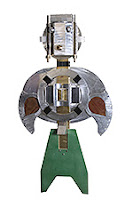
That’s why, on the trip home, when we saw the sculpture called Atomic Thunderbird by Tony Price at the Albuquerque Museum, again on our way to stay in Socorro on the last night of the trip, I was so intensely affected by it. I was impressed by Price’s dedication to his art, to what he consciously thought of as beating swords into plowshares. I found it moving and immediately thought of him as a kindred spirit.

Self-styled Atomic Artist Tony Price was only eight years old when the first atomic bomb was set off near Alamogordo. He was living in New York at the time, but he was later deeply affected by the event. After he moved to New Mexico in the 1960s, he began to visit the salvage yard at the Los Alamos National Laboratories, where he mined the glass and metal pieces he found there and turned them into sculptures like Atomic Thunderbird. He began to focus his life as an artist on what he called "our nuclear nightmare." 


Trinity Site obelisk. The black plaque on top reads: Trinity Site Where The World's First Nuclear Device Was Exploded On July 16, 1945. This file is licensed under the Creative Commons Attribution-Share Alike 2.0 Generic license. Source: Samat Jain - Flickr: Trinity Site Obelisk National Historic Landmark


Atomic Thunderbird
, made of salvaged stainless steel, bronze, plastic, and fiberglass, radiates a good-natured strength, seemingly unaware of its toxic lineage. Its round head, eyes, and torso give it a biomorphic quality. The title implies that it has some relationship to American Indian mythological birdlike entities of the same name that symbolize power and strength, and thunderbirds from many American Indian belief systems have the power of the storm at their command. In its squat build it resembles some thunderbird depictions that I see online, but Price’s thunderbird reference is more a matter of resonance than cultural appropriation. The Atomic Thunderbird has no feathers, though maybe those curved shapes on either side of its body are wings. Its tail is like the tail of a rocket, its center implies no heart but only a machine’s cold workings, its color is a silver cleansed of traces of life. So Thunderbird yes, in the sense of an entity that’s powerful, and no, in the sense of an organism that could save humans from anything, particularly themselves.

I recently learned that some of Price’s Atomic Art sculptures are on display at Biosphere 2 in Oracle, AZ, which means his kindred-spirit approach to nuclear anxiety is still available to me, now that I’m home. 

Monday, March 30, 2020

Spring in the Time of Coronavirus


Winter rains have been good this year, and wildflowers grow in profusion beside our neighborhood walking path. As local government decrees keep us closer to home (most recently we have been strongly advised by our mayor to stay there as much as possible), a small group of us walk our dogs at the same time each morning, maintaining social distancing.

The colors of these wildflowers are deeper and more vibrant than the colors of wildflowers I remember back East. Their English names, which I learned when I first came to Arizona, often simply add the word “desert” to  the names of common garden flowers.
Desert penstemon
There are many spikes of desert penstemon, their pink flowers like small trumpets calling bees and hummingbirds. Half a dozen or more stems cluster together and grow 2-3 feet tall.

Brittlebush
We don’t have Mexican gold poppies here, but yellow-flowered brittlebush seems to be everywhere, and each plant is filled with dozens of blooms. There are also desert marigolds and other, smaller, less showy yellow flowers, too.
Desert marigold
Desert verbena is low to the ground and less plentiful, but its blue-violet blooms are fragrant and long-lasting.
Desert verbena
And then there's desert globemallow, with many orange, cup-shaped flowers on each shrubby plant.

Desert globemallow
After our walk the other day, as Greg and I headed for home, we saw a turkey vulture on top of a phone pole, wings raised to the morning sun. This action, like our frequent handwashing during this time of COVID-19, is a way to vanquish microbes. The raised wings make the big bird look like a supplicant, its red head vulnerable in the early morning light.
Turkey vulture with one wing raised
The vulture is a living symbol, bearing its guilt by association as a carrion eater, and so our morning walk was like a living vanitas. Those paintings were intended to remind us of our own mortality — telling us to remember that life is very short and we will all die. Symbols found in vanitas paintings often include skulls, fruit, and flowers, but a vulture will certainly do as a reminder that all is vanity.

Aloe vera flowers
Even so, as we walked through the back gate, I noticed how much progress spring is making -- the succulents are starting to bloom and get new growth. The aloe vera plants are sending up spiny stalks and unfolding orange flowers. The prickly pear cactus are making lots of undifferentiated buds that are hard to tell apart at first but it soon becomes clear which will be flowers and which will be new pads.

Prickly pear budding
And though I am existentialist enough to think frequently about how short life is, I still wanted to show off my pictures and say what I think about them. Because all may be vanity, but the world is still a sight to behold.

Some Thoughts About the Desert Landscape After Reading Natalie Koch’s Arid Empire and Seeing Sofía Córdova's “Sin Agua”

I wrote this post last spring and never got around to putting it online. Sofía Córdova's “Sin Agua” just closed at the Museum of Contemp...